Entertainment · Research

Faith &
entertainment
index.

Faith, storytelling, and its influence on modern American audiences.

A groundbreaking new study explores how today’s TV and film audiences respond to faith on screen.

A roadmap for filmmakers

What makes a story connect?

Scenes tested
106
Interviews
12,723
Social insights
38k+

How can creators tell authentic stories with faith in a way that tangibly builds engagement?

Why do some stories land better than others?

The index brings audience responses, social listening, and research-informed AI coding together to examine what happens when faith becomes part of the story.

The research sampleAudiences across generations.
Ages 18–34
26%
Ages 35–49
24%
Ages 50–64
25%
Ages 65+
25%

Age distribution of survey respondents · HarrisX

The foundation

How the research was conducted.

Published 2026
Fieldwork: September 9–18 and November 13–25, 2025.

Modern audiences in America

Professionally recruited consumers who watch TV or movies at least weekly completed an online survey. Jewish and Muslim respondents were oversampled to achieve readable samples among major U.S. faith groups. Religious affiliation was weighted to reflect the U.S. population.

56% watch TV or movies daily. 78% identify as spiritual, religious, or a person of faith.

Age breakdown
Age breakdown
AgeShare
18–3426%
35–4924%
50–6425%
65+25%
Gender breakdown
Gender breakdown
GenderShare
Male50%
Female50%
Religiosity
Religiosity
IdentityShare
Spiritual35%
Religious38%
Person of faith40%
None of the above22%
Religious identity
Religious identity
IdentityRespondents
Christian5,579
Catholic2,072
Protestant2,266
Jewish2,467
Muslim2,652
Eastern religions90
Other religion265
Atheist / agnostic1,538

Religiosity is a multiple-response measure. Catholic and Protestant are included within Christian identity, so these rows should not be added as separate groups.

Qualitative research and supplementary analysis

The report describes 32 avid entertainment consumers in its qualitative phase, recruited for a diverse mix of demographics and ideologies. The quantitative phase tested 106 scenes from 50 series and films.

Organic YouTube comments were grouped into themes. A research-informed AI taxonomy of more than 130 tones was then used to code the scenes consistently.

Read methodology and coding details in the report

A first-of-its-kind evaluation system

Three ways to measure impact.

Each scene is evaluated against three core pillars. The weights reflect their relative contribution to the index.

01 · Entertainment value

×1

Measuring appeal and likeability.

Survey questions
  • How much did you like or dislike this scene?
02 · Faith portrayal

×1.5

Authenticity, accuracy, and storytelling features.

Survey questions
  • How well or poorly do you think faith was portrayed?
  • To what extent do you agree or disagree that each of the following describes this scene? (Average agreement across all “totems”.)

03 · Engagement impact

×2

Sentiment and interest in future content.

Survey questions
  • Overall, did this scene make you think more positively or negatively about faith, or did it have no impact?
  • How did this scene affect your interest in seeing the full show, film, or more content like it?
Explore all consumer-defined storytelling features

The study calls these features “totems.”

Entertainment features

  • Feels like it’s made for people like me
  • Is relatable
  • Is easy to understand
  • Avoids clichés or overused tropes
  • Makes you reflect or think differently
  • Has characters who feel layered and complex
  • Connects to broader social issues
  • Shows realistic characters and situations
  • Uses humor respectfully
  • Is emotionally moving
  • Is entertaining

Faith-specific features

  • Depicts faith authentically
  • Depicts faith through relatable, everyday experiences
  • Depicts faith accurately
  • Shows different perspectives within a faith
  • Shows characters exploring their faith
  • Places faith in contemporary or modern settings
  • Weaves faith naturally into the story or journey
  • Teaches something new about faith
  • Challenges common stereotypes about faith
  • Appeals to people of a different faith
  • Appeals to people with no faith or spirituality
  • Avoids offending people of a particular faith
  • Avoids preachy or heavily faith-based language

2026 Faith & Entertainment Index · HarrisX

The top 10

The scenes that stayed with people.

Explore the scenes audiences found most impactful. Open a profile for audience scores, storytelling features, and viewer responses.

Ranked by the all-consumer index. Scores are weighted index values, not percentages.
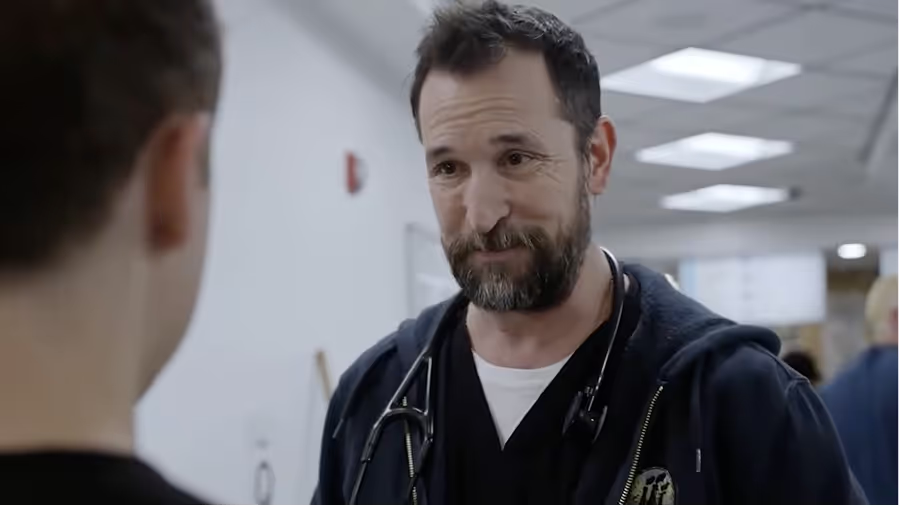
01The PittDr. Robby Thanks WhitakerJudaism80.6Index score

The Pitt: Dr. Robby Thanks Whitaker — scene analysis

Watch scene

"7:00 PM," The Pitt, S1, E13 (2025), HBO Max, et. Al.

All Consumers
80.6Rank #1
Christian Consumers
86.0Rank #2
Jewish Consumers
84.5Rank #1
Muslim Consumers
91.4Rank #10

Weighted index scores, not percentages. Audience ranks refer to all 106 tested scenes.

Top storytelling features

Shows characters exploring their faith77%
Weaves faith naturally into the story or character journey75%
Places faith in contemporary/modern settings75%
View data table
The Pitt: Dr. Robby Thanks Whitaker · Top storytelling features
Audience / measurePercent
Shows characters exploring their faith77%
Weaves faith naturally into the story or character journey75%
Places faith in contemporary/modern settings75%

Scoring inputs · all consumers

Entertainment impact86%
Faith portrayal77%
Engagement impact75%
View data table
The Pitt: Dr. Robby Thanks Whitaker · Scoring inputs · all consumers
Audience / measurePercent
Entertainment impact86%
Faith portrayal77%
Engagement impact75%

In their own words

"It shows that in the darkest times of life, people can look to God for courage and strength."
“It shows characters genuinely grappling with their beliefs in a meaningful way.”
AI coding analysis

  • Coping With Tragedy: The emotional breakdown and subsequent effort to manage immense loss and grief
  • Professional Endurance: The commitment to duty and service even when personally devastated
  • Support and Solidarity: The act of one colleague offering critical emotional assistance to another
View the report’s scene profile
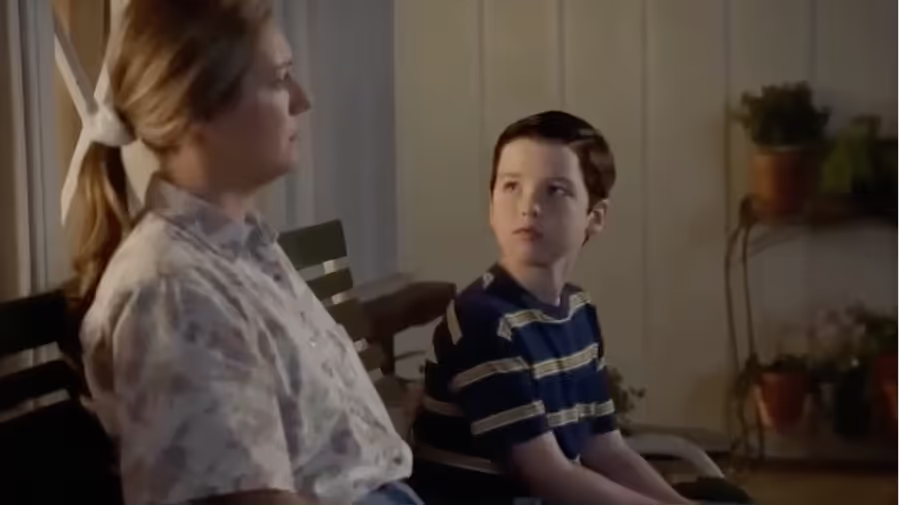
02Young SheldonSheldon Convincing Mom to Believe in GodChristianity78.2Index score

Young Sheldon: Sheldon Convincing Mom to Believe in God — scene analysis

Watch scene

"A Crisis of Faith and Octopus Aliens," Young Sheldon, S2, E3 (2017), CBS, et. al.

All Consumers
78.2Rank #2
Christian Consumers
86.2Rank #3
Jewish Consumers
78.5Rank #12
Muslim Consumers
91.9Rank #8

Weighted index scores, not percentages. Audience ranks refer to all 106 tested scenes.

Top storytelling features

Is easy to understand76%
Is emotionally moving74%
Shows realistic characters and situations73%
View data table
Young Sheldon: Sheldon Convincing Mom to Believe in God · Top storytelling features
Audience / measurePercent
Is easy to understand76%
Is emotionally moving74%
Shows realistic characters and situations73%

Scoring inputs · all consumers

Entertainment impact85%
Faith portrayal77%
Engagement impact71%
View data table
Young Sheldon: Sheldon Convincing Mom to Believe in God · Scoring inputs · all consumers
Audience / measurePercent
Entertainment impact85%
Faith portrayal77%
Engagement impact71%

In their own words

“It shows how people have questions about their faith but continue to try to understand it.”
“The character belief were expressed genuinely and with emotional depth, making their faith seem authentic.”
AI coding analysis

  • Doubt and Faith: Mary grapples with her belief system, while Sheldon attempts to re-affirm it
  • Parental Guilt/Struggle: Mary feels she must navigate her faith crisis alone and shield her child
  • Divine Design/Fine-tuning: Sheldon uses scientific observations to suggest an intelligent creator's existence
Social media listening

Emotional & Heartwarming

Viewers emphasize Sheldon's love for his mother; human bond before ideology

"As much as I enjoy the humor in this show, the main reason I love Young Sheldon so much is because of the sweet and heartwarming moments like this."

Struggling With Faith

Debate over belief in God and scripture

“It highlights the very real struggle many believers sometimes battle. With great sensitivity, the writers [brilliantly] portrayed that struggle.”

Finding Comfort in One's Own Spiritual Journey

Viewers reflect on how the scene validates personal, evolving relationships with faith

“It's not about if God really exists or not, it's the belief that helps us live with peace.”

“…Sheldon didn't jump on God conclusion directly hearing from others mouth, he went through a journey of knowledge.”

View the report’s scene profile
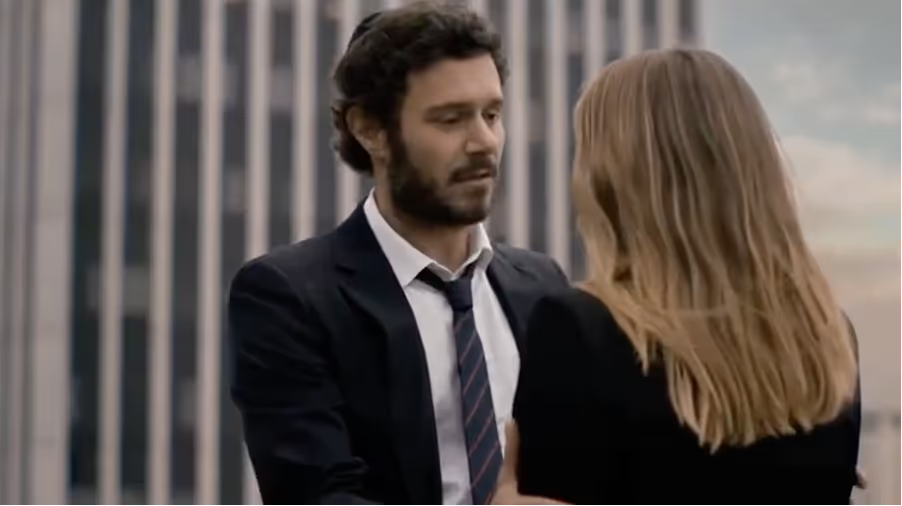
03Nobody Wants ThisI Love YouJudaism77.8Index score

Nobody Wants This: I Love You — scene analysis

Watch scene

"Bat Mitzvah Crashers," Nobody Wants This, S1, E10 (2024), Netflix, et. al.

All Consumers
77.8Rank #3
Christian Consumers
81.1Rank #7
Jewish Consumers
82.0Rank #3
Muslim Consumers
86.8Rank #43

Weighted index scores, not percentages. Audience ranks refer to all 106 tested scenes.

The source webpage lists Muslim rank #87; the downloadable report (p. 42) lists #43. This profile follows the report.

Top storytelling features

Is easy to understand80%
Shows realistic characters and situations78%
Shows characters exploring their faith77%
View data table
Nobody Wants This: I Love You · Top storytelling features
Audience / measurePercent
Is easy to understand80%
Shows realistic characters and situations78%
Shows characters exploring their faith77%

Scoring inputs · all consumers

Entertainment impact88%
Faith portrayal78%
Engagement impact68%
View data table
Nobody Wants This: I Love You · Scoring inputs · all consumers
Audience / measurePercent
Entertainment impact88%
Faith portrayal78%
Engagement impact68%

In their own words

“The characters show sincerity and depth in their beliefs. That emotional honesty is what made it stand out as a good portrayal.”
“Rather than being a theatrical display, their generosity and humility were a reflection of genuine religion.”
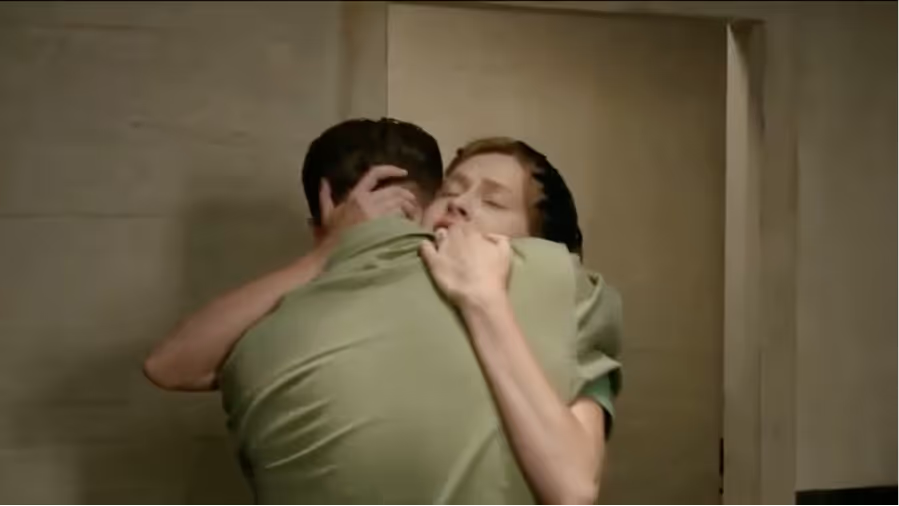
AI coding analysis

  • Interfaith Romance: Navigating the difficulties and nuances of a relationship between people of two different faiths
  • Identity & Belonging: Joanne grapples with adopting a new religious identity to fit into his world
  • Personal Integrity: Joanne refuses to convert for her partner, prioritizing her authentic self
View the report’s scene profile
04Hacksaw RidgePlead GuiltyChristianity77.4Index score

Hacksaw Ridge: Plead Guilty — scene analysis

Watch scene

Hacksaw Ridge (2016), Lionsgate, et. al.

All Consumers
77.4Rank #4
Christian Consumers
87.1Rank #1
Jewish Consumers
78.4Rank #13
Muslim Consumers
93.0Rank #3

Weighted index scores, not percentages. Audience ranks refer to all 106 tested scenes.

Top storytelling features

Weaves faith naturally into the story or character journey73%
Shows characters exploring their faith73%
Is emotionally moving73%
View data table
Hacksaw Ridge: Plead Guilty · Top storytelling features
Audience / measurePercent
Weaves faith naturally into the story or character journey73%
Shows characters exploring their faith73%
Is emotionally moving73%

Scoring inputs · all consumers

Entertainment impact82%
Faith portrayal74%
Engagement impact72%
View data table
Hacksaw Ridge: Plead Guilty · Scoring inputs · all consumers
Audience / measurePercent
Entertainment impact82%
Faith portrayal74%
Engagement impact72%

In their own words

“Because the character is trusting in something unseen despite the odds which reflects true faith.”
“He was willing to stand by the guidelines of his faith and not use a gun to kill.”

AI coding analysis

  • Moral Integrity: Doss maintains his convictions despite intense pressure and the risk of court-martial
  • Personal Conviction: His unwavering adherence to his principles, rooted in his faith, even when it means facing imprisonment
  • Sacrifice: The personal cost Desmond and his loved ones face due to his commitment to his faith
View the report’s scene profile
05Hacksaw RidgeDesmond Asks God for StrengthChristianity77.3Index score

Hacksaw Ridge: Desmond Asks God for Strength — scene analysis

Watch scene

Hacksaw Ridge (2016), Lionsgate, et. al.

All Consumers
77.3Rank #5
Christian Consumers
81.9Rank #6
Jewish Consumers
78.7Rank #9
Muslim Consumers
90.4Rank #15

Weighted index scores, not percentages. Audience ranks refer to all 106 tested scenes.

Top storytelling features

Is easy to understand73%
Has characters who feel layered and complex73%
Is emotionally moving72%
View data table
Hacksaw Ridge: Desmond Asks God for Strength · Top storytelling features
Audience / measurePercent
Is easy to understand73%
Has characters who feel layered and complex73%
Is emotionally moving72%

Scoring inputs · all consumers

Entertainment impact83%
Faith portrayal73%
Engagement impact72%
View data table
Hacksaw Ridge: Desmond Asks God for Strength · Scoring inputs · all consumers
Audience / measurePercent
Entertainment impact83%
Faith portrayal73%
Engagement impact72%

In their own words

“It shows faith in a light of following through even in the toughest circumstances when we don't think we can but yet with faith we can.”
“It shows genuine belief, struggles, and hope, feeling realistic and relatable.”
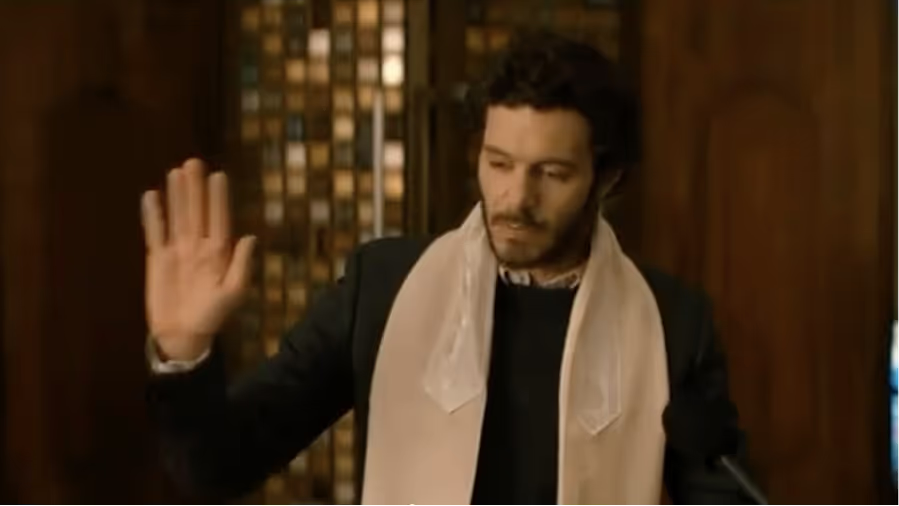
AI coding analysis

  • Sacrifice: Desmond risks his life repeatedly to save soldiers in a deadly warzone
  • Personal Conviction: Desmond stays steadfast in his commitment to his conscientious objector vows in the face of battle
  • Faith While Under Fire : Putting his faith in God despite the horrors of war
Social media listening

Faith & Prayer

Viewers describe Desmond’s actions as a model of prayer & righteousness

“I love how Desmond is asking God what he wants from him and not asking why this is happening.”

Reframing Heroism

Discussions about faith-rooted heroism

“Now that’s courage, when you’re broken and still choose to help.”

Emotional & Spiritual Inspiration

Desmond’s prayer becomes a motivational template

“This scene motivates me to be better.”

"One of the best and most powerful scenes in movie history.”

Hollywood’s Anti-faith Bias

Some view the film as victim

“This movie didn’t get an Oscar because it’s too religious.”

View the report’s scene profile
06Nobody Wants ThisNoah's SermonJudaism77Index score

Nobody Wants This: Noah's Sermon — scene analysis

The source embeds a Hacksaw Ridge clip here. The scene reference is “Pilot,” Nobody Wants This, S1 E1, 22:20–23:45 on Netflix.

"Pilot," Nobody Wants This, S1, E1 (2024), Netflix, et. al.; Time stamp for the clip on Netflix is (22:20-23:45)

All Consumers
77Rank #6
Christian Consumers
82.1Rank #4
Jewish Consumers
80.5Rank #7
Muslim Consumers
90.1Rank #16

Weighted index scores, not percentages. Audience ranks refer to all 106 tested scenes.

Top storytelling features

Is easy to understand78%
Places faith in contemporary/modern settings75%
Shows characters exploring their faith72%
View data table
Nobody Wants This: Noah's Sermon · Top storytelling features
Audience / measurePercent
Is easy to understand78%
Places faith in contemporary/modern settings75%
Shows characters exploring their faith72%

Scoring inputs · all consumers

Entertainment impact87%
Faith portrayal74%
Engagement impact70%
View data table
Nobody Wants This: Noah's Sermon · Scoring inputs · all consumers
Audience / measurePercent
Entertainment impact87%
Faith portrayal74%
Engagement impact70%

In their own words

“[The scene] indicated that all you have to do is look around and God is there with you.”
“The way the Rabbi brings everyday occurrences to religion. It’s a good way to bring faith in a relatable manner.”
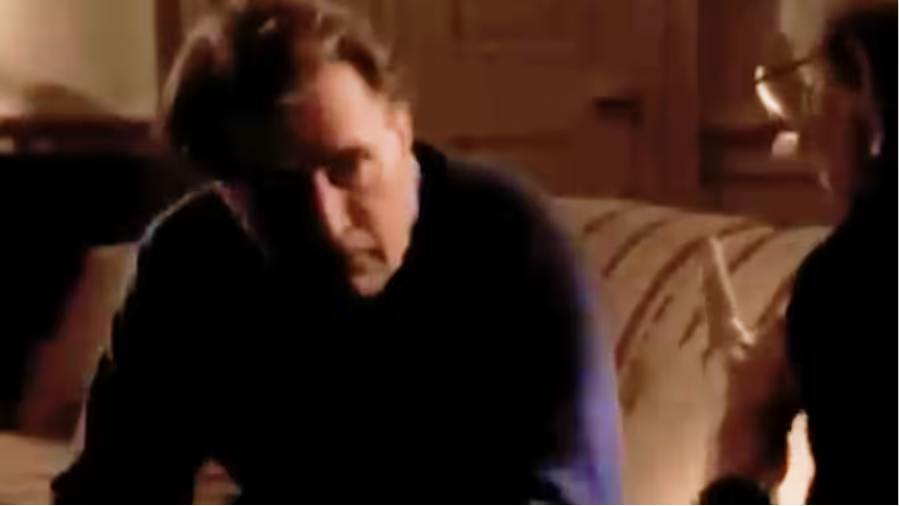
AI coding analysis

  • Everyday Signs & Spiritual Purpose: The sermon reframes the drowning-man parable to show that life’s “signals” come through ordinary experiences
  • Personal Awakening: As Noah speaks, Joanne, who isn’t religious, connects with the message
  • Agency in Changing One’s Path : His sermon urges people to wake up, make choices, and reshape their lives instead of waiting for a divine signal
View the report’s scene profile
07The West WingParable ConversationChristianity76.2Index score

The West Wing: Parable Conversation — scene analysis

Watch scene

"Take This Sabbath Day," The West Wing, S1, E14 (2000), National Broadcasting Company (NBC), et. al.

All Consumers
76.2Rank #7
Christian Consumers
80.3Rank #10
Jewish Consumers
75.5Rank #25
Muslim Consumers
86.1Rank #51

Weighted index scores, not percentages. Audience ranks refer to all 106 tested scenes.

Top storytelling features

Is easy to understand79%
Shows characters exploring their faith70%
Shows realistic characters and situations70%
View data table
The West Wing: Parable Conversation · Top storytelling features
Audience / measurePercent
Is easy to understand79%
Shows characters exploring their faith70%
Shows realistic characters and situations70%

Scoring inputs · all consumers

Entertainment impact82%
Faith portrayal73%
Engagement impact70%
View data table
The West Wing: Parable Conversation · Scoring inputs · all consumers
Audience / measurePercent
Entertainment impact82%
Faith portrayal73%
Engagement impact70%

In their own words

“…It shows that faith can coexist with uncertainty, which makes it more relatable and real.”
“Because that scene was about God helps those who help themselves, and not that you’re waiting on a miracle from God.”
AI coding analysis

  • Divine vs. Human Will: The tension between heavenly guidance and earthly responsibility in decision-making
  • Misguided Faith: The danger of passive belief without corresponding action or recognition of divine gifts
  • Interpretation of Signs: The challenge of discerning God’s will and recognizing help in everyday events
Social media listening

Grief & rage at God: Viewers relate Bartlet’s grief to their own losses.

Parable interpretation & theology: Comments discuss divine providence and the drowning-man parable.

Acting & writing: Viewers praise the performance.

Relationship with the priest: Comments explore pastoral guidance and spiritual fatherhood.

Leadership & humanity: Viewers reflect on grief and responsibility in office.

View the report’s scene profile
08Hacksaw RidgeDesmond is Jailed & Speaks in CourtChristianity75.9Index score

Hacksaw Ridge: Desmond is Jailed & Speaks in Court — scene analysis

Watch scene

Hacksaw Ridge (2016), Lionsgate, et. al.

All Consumers
75.9Rank #8
Christian Consumers
80.8Rank #8
Jewish Consumers
74.7Rank #30
Muslim Consumers
87.6Rank #30

Weighted index scores, not percentages. Audience ranks refer to all 106 tested scenes.

Top storytelling features

Is easy to understand76%
Shows realistic characters and situations74%
Is emotionally moving69%
View data table
Hacksaw Ridge: Desmond is Jailed & Speaks in Court · Top storytelling features
Audience / measurePercent
Is easy to understand76%
Shows realistic characters and situations74%
Is emotionally moving69%

Scoring inputs · all consumers

Entertainment impact86%
Faith portrayal70%
Engagement impact71%
View data table
Hacksaw Ridge: Desmond is Jailed & Speaks in Court · Scoring inputs · all consumers
Audience / measurePercent
Entertainment impact86%
Faith portrayal70%
Engagement impact71%

In their own words

“The guy was sticking to his beliefs and his morals with no compromise.”
“…it captured the depth, complexity, and emotional truth of what it means to believe.”
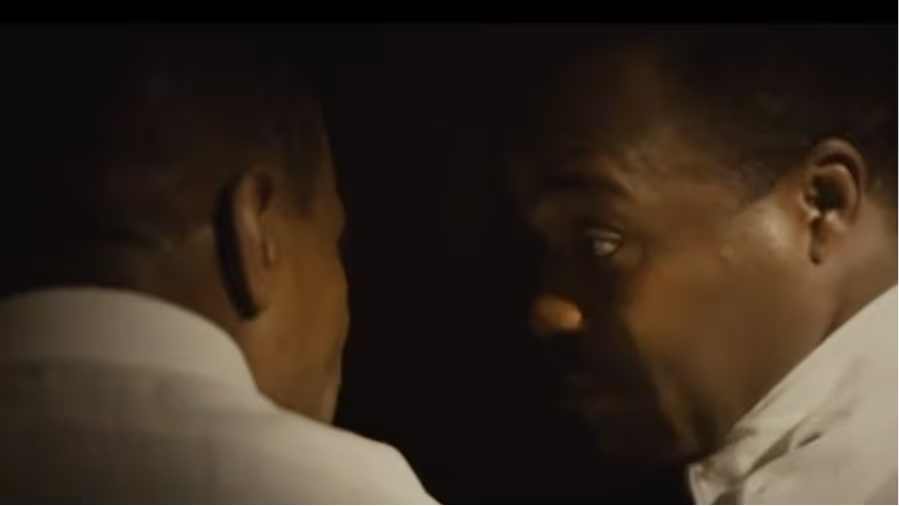
AI coding analysis

  • Moral Integrity: Doss maintains his convictions despite intense pressure and the risk of court-martial
  • Duty v. Belief: The conflict between military duty (bearing arms) and personal religious belief (not killing)
  • Selfless Service: Doss’ desire to still contribute to the war effort and risk his life by saving, not taking, lives
Social media listening

Religious conviction: Viewers connect Doss’s stand with Christian belief and a personal covenant.

Courage: Comments emphasize moral conviction, sacrifice, and facing danger unarmed.

Historical accuracy: The true-story context strengthens viewers’ emotional response.

View the report’s scene profile
09SelmaMLK Jr. in JailChristianity73.6Index score

Selma: MLK Jr. in Jail — scene analysis

Watch scene

Selma (2015), Paramount Pictures, et. al.

All Consumers
73.6Rank #9
Christian Consumers
79.2Rank #11
Jewish Consumers
76.6Rank #21
Muslim Consumers
89.6Rank #19

Weighted index scores, not percentages. Audience ranks refer to all 106 tested scenes.

Top storytelling features

Is easy to understand74%
Shows realistic characters and situations74%
Has characters who feel layered and complex73%
View data table
Selma: MLK Jr. in Jail · Top storytelling features
Audience / measurePercent
Is easy to understand74%
Shows realistic characters and situations74%
Has characters who feel layered and complex73%

Scoring inputs · all consumers

Entertainment impact80%
Faith portrayal72%
Engagement impact66%
View data table
Selma: MLK Jr. in Jail · Scoring inputs · all consumers
Audience / measurePercent
Entertainment impact80%
Faith portrayal72%
Engagement impact66%

In their own words

“It showed unwavering belief despite doubt, struggle, and uncertain outcomes.”
“The characters express their beliefs through sincere conversations and actions, making it feel authentic and heartfelt.”
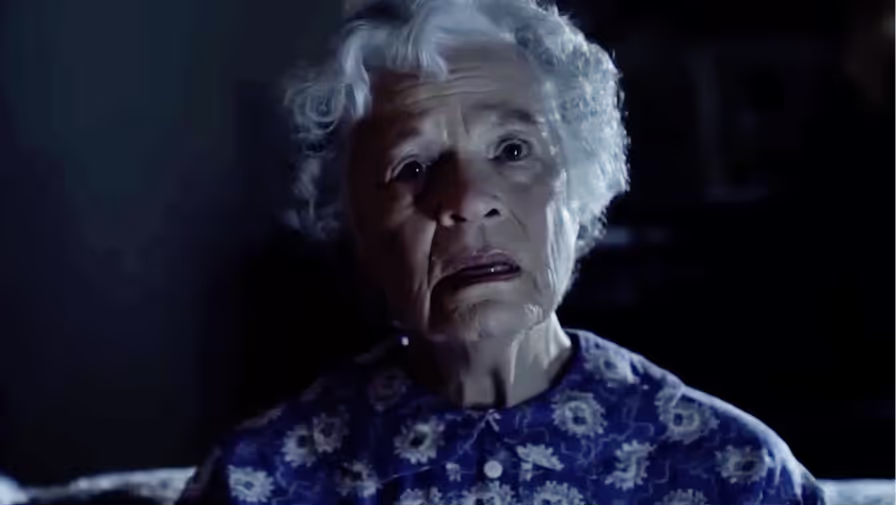
AI coding analysis

  • Systemic Injustice: Highlighting the deeply rooted racial discrimination and its devastating impact
  • Spiritual Sustenance: Finding strength and guidance through faith and scripture during times of adversity
  • Resilience in Struggle: The unwavering commitment to continue to fight for justice despite immense suffering
View the report’s scene profile
10God's Not DeadSin is Like a Jail CellChristianity73.3Index score

God's Not Dead: Sin is Like a Jail Cell — scene analysis

Watch scene

God's Not Dead (2014), Pure Flix, et. al.

All Consumers
73.3Rank #10
Christian Consumers
80.6Rank #9
Jewish Consumers
74.2Rank #34
Muslim Consumers
86.0Rank #52

Weighted index scores, not percentages. Audience ranks refer to all 106 tested scenes.

Top storytelling features

Is easy to understand73%
Is emotionally moving70%
Places faith in contemporary/modern settings70%
View data table
God's Not Dead: Sin is Like a Jail Cell · Top storytelling features
Audience / measurePercent
Is easy to understand73%
Is emotionally moving70%
Places faith in contemporary/modern settings70%

Scoring inputs · all consumers

Entertainment impact75%
Faith portrayal71%
Engagement impact68%
View data table
God's Not Dead: Sin is Like a Jail Cell · Scoring inputs · all consumers
Audience / measurePercent
Entertainment impact75%
Faith portrayal71%
Engagement impact68%

In their own words

“Because the comparison of the woman's life to a sinner fits well and makes you question God.”
“It shows faith as personal, not preachy.”

AI coding analysis

  • Suffering vs. Faith: A man challenges an elderly woman's lifelong faith due to her debilitating illness
  • Spiritual Complacency: The woman describes how the devil allows an easy life to deter people from God
  • Consequences of Sin: Sin is depicted as a comfortable prison that eventually traps and seals one's fate
Social media listening

Sin as comfortable captivity: Viewers discuss the scene as a statement of Christian identity.

Debate with skeptics: Comments become a discussion of belief and disbelief.

Spiritual battle: Viewers discuss temptation, salvation, and what people desire.

View the report’s scene profile

When stories connect, success follows

Ten scenes. Seven successful stories.

The study’s top scenes come from award-winning, widely watched titles.
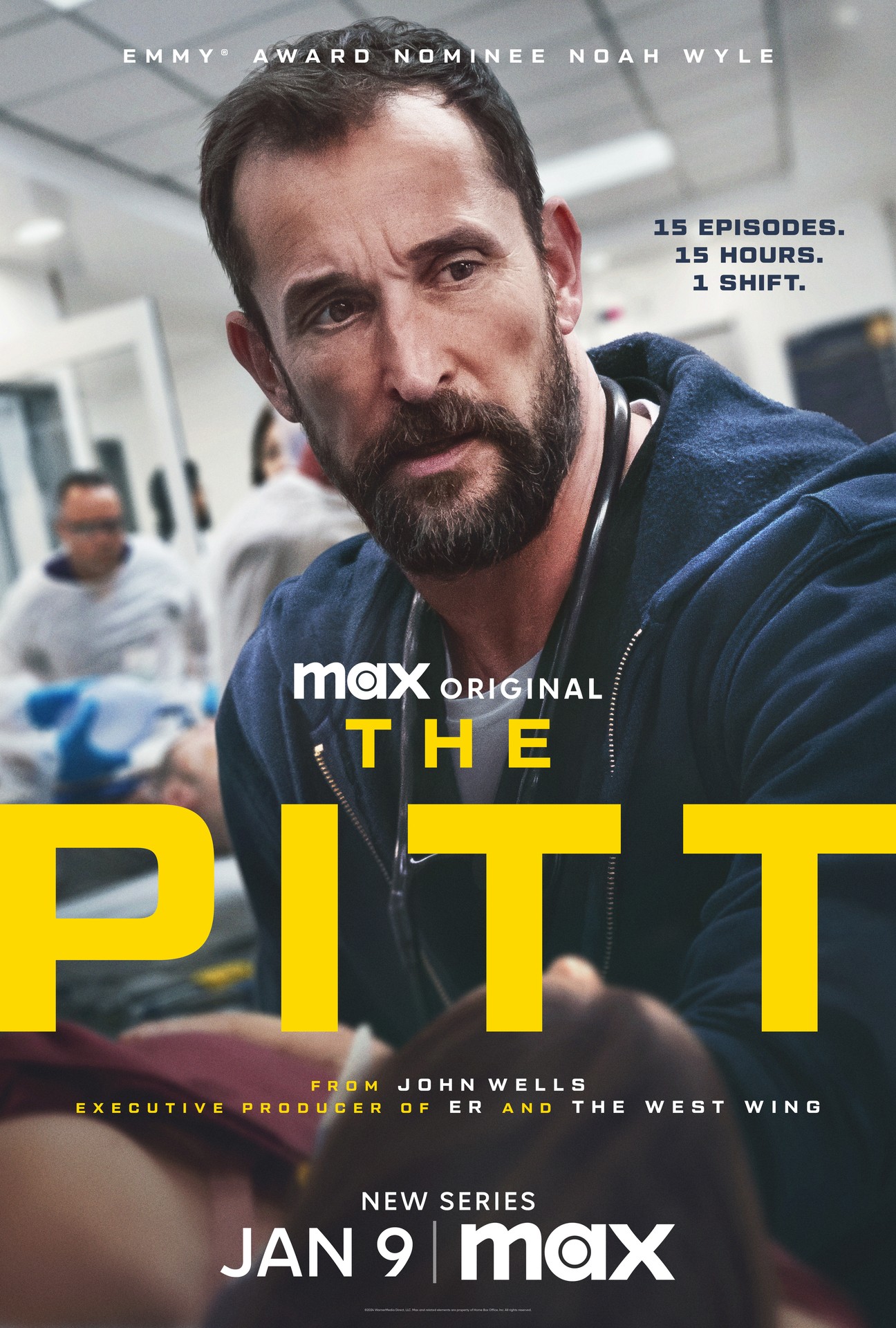
The Pitt poster

The Pitt

  • 2 Golden Globes
  • 5 Emmy awards
  • 10M+ average views globally
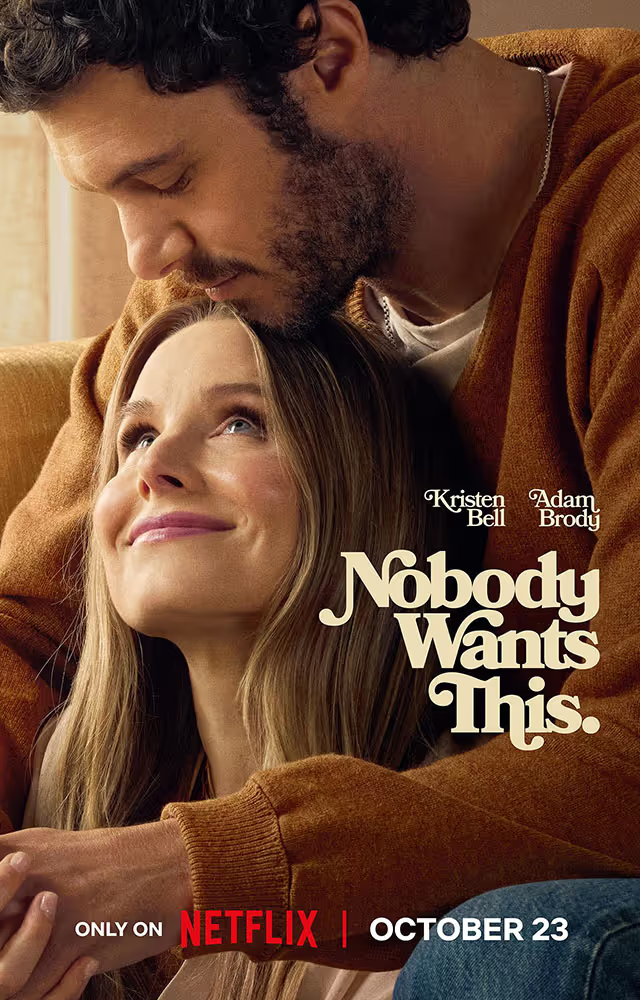
Nobody Wants This poster

Nobody Wants This

  • #1 Netflix globally
  • 15M+ average views
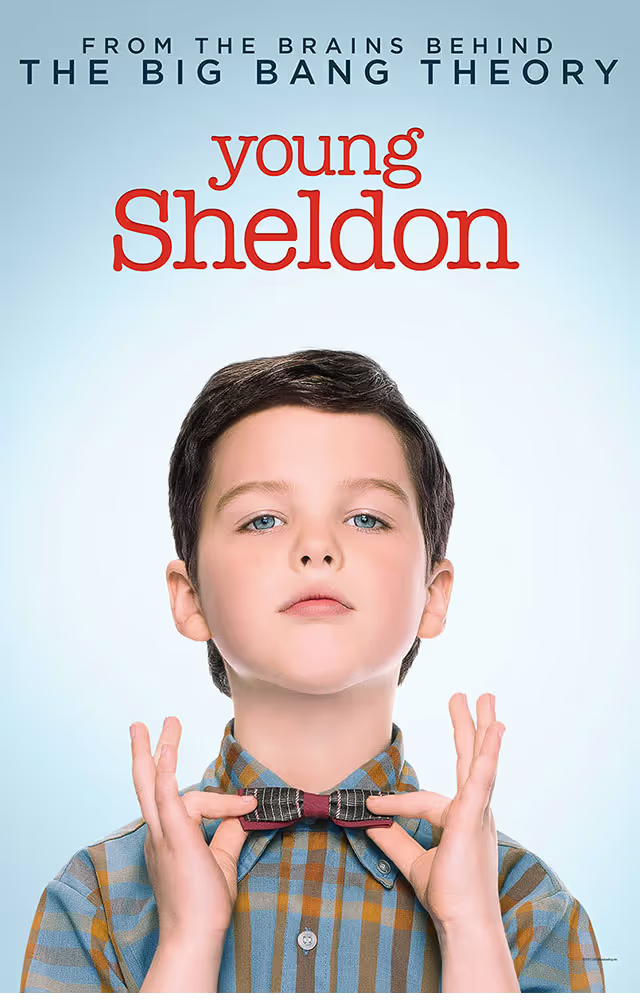
Young Sheldon poster

Young Sheldon

  • 3 Family Film & TV awards
  • Kid’s Choice awards
  • 12M+ average views globally
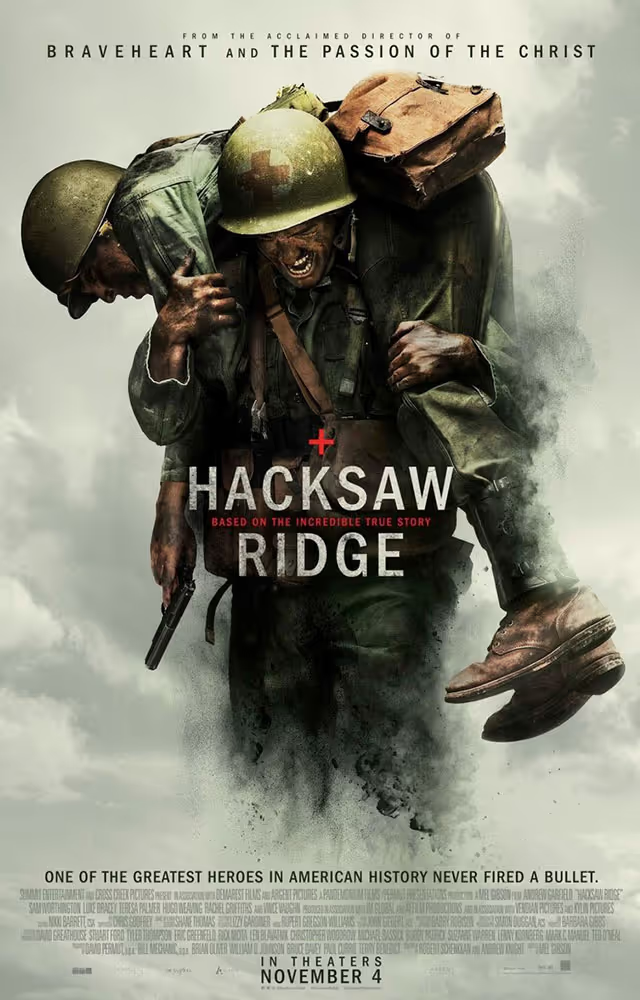
Hacksaw Ridge poster

Hacksaw Ridge

  • $180M+ gross worldwide
  • 2 Oscars awards
  • Nominated for an additional 4
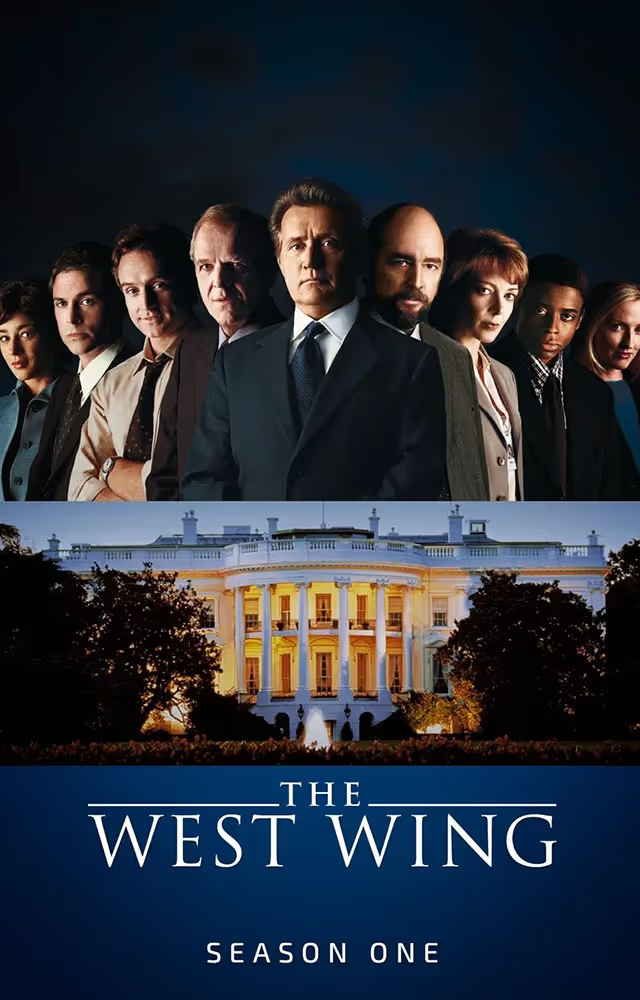
The West Wing poster

The West Wing

  • 26 Emmy
  • 2 Peabody
  • 3 Golden Globe awards
  • 17M+ average views globally
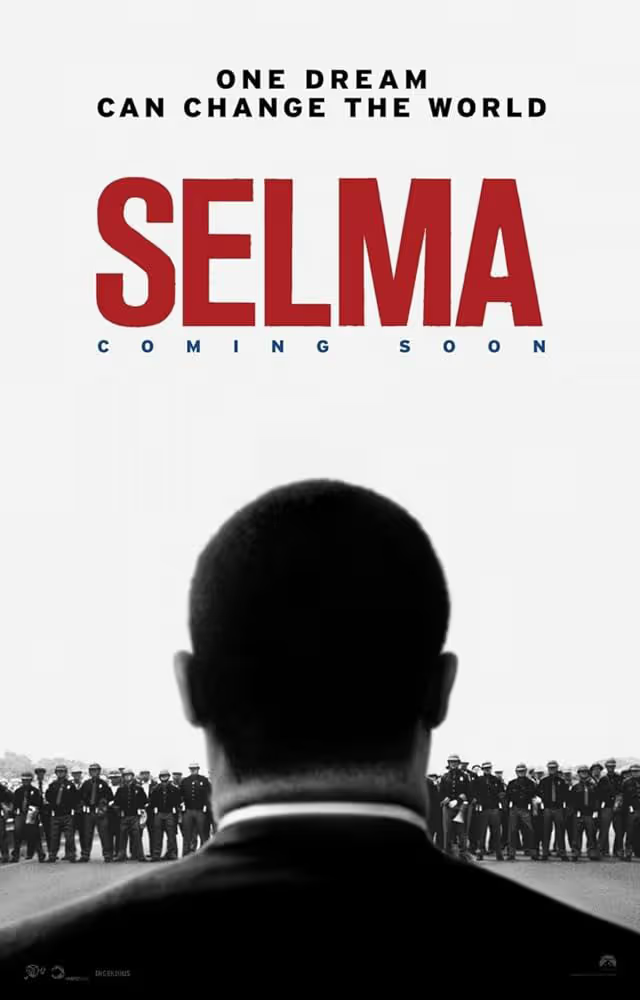
Selma poster

Selma

  • Oscar nomination for Best Picture
  • Grossed nearly $70M globally
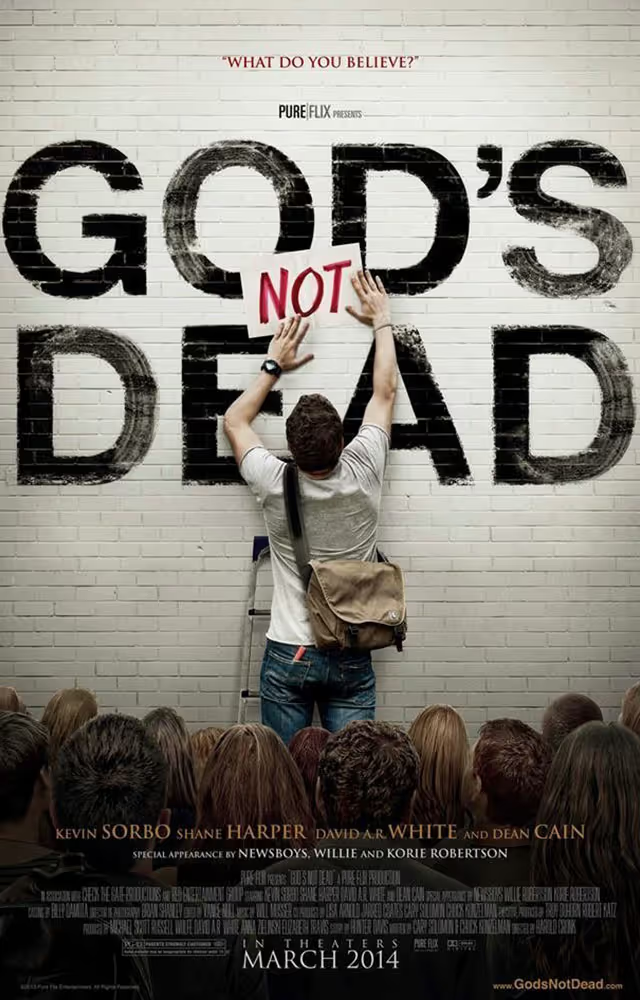
God’s Not Dead poster

God’s Not Dead

  • $58M profit

Awards and audience figures are as published in the 2026 index; they are not live totals.

The findings

Faith. Honesty. Familiarity.

01 · Faith drives engagement

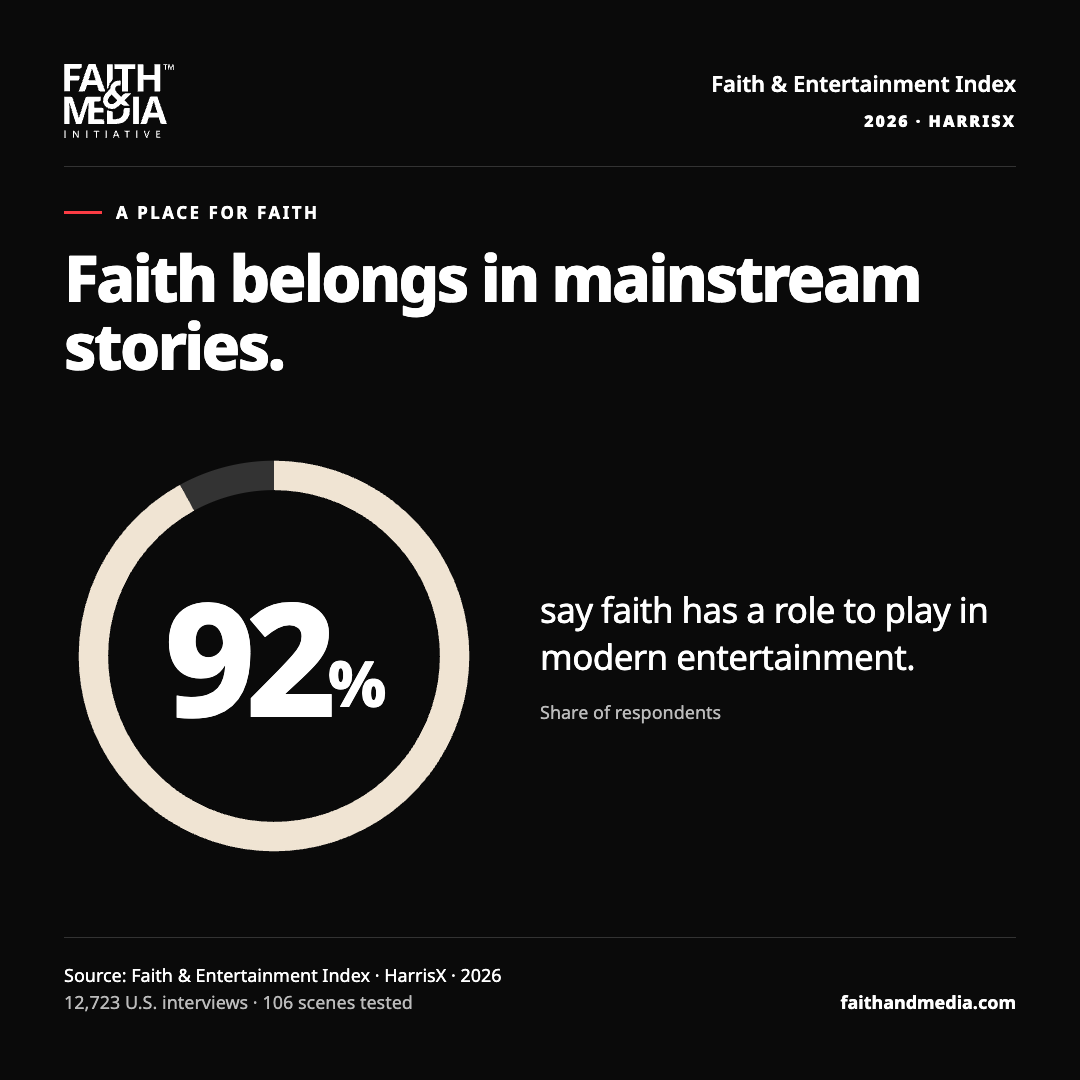
Faith belongs in mainstream stories.

92%

Open to faith representation in entertainment.

Most viewers see a place for faith, whether central to the story, part of the background, or present through subtle references.

Where audiences see a role for faith

Central to the story23%
Present, but not the main focus51%
Subtle, light references18%
Not at all8%
View data table
Where audiences see a role for faith
Audience / measurePercent
Central to the story23%
Present, but not the main focus51%
Subtle, light references18%
Not at all8%

The three forms of inclusion total 92%. Report p. 14.

2026 Faith & Entertainment Index · HarrisX

01 · Faith drives engagement

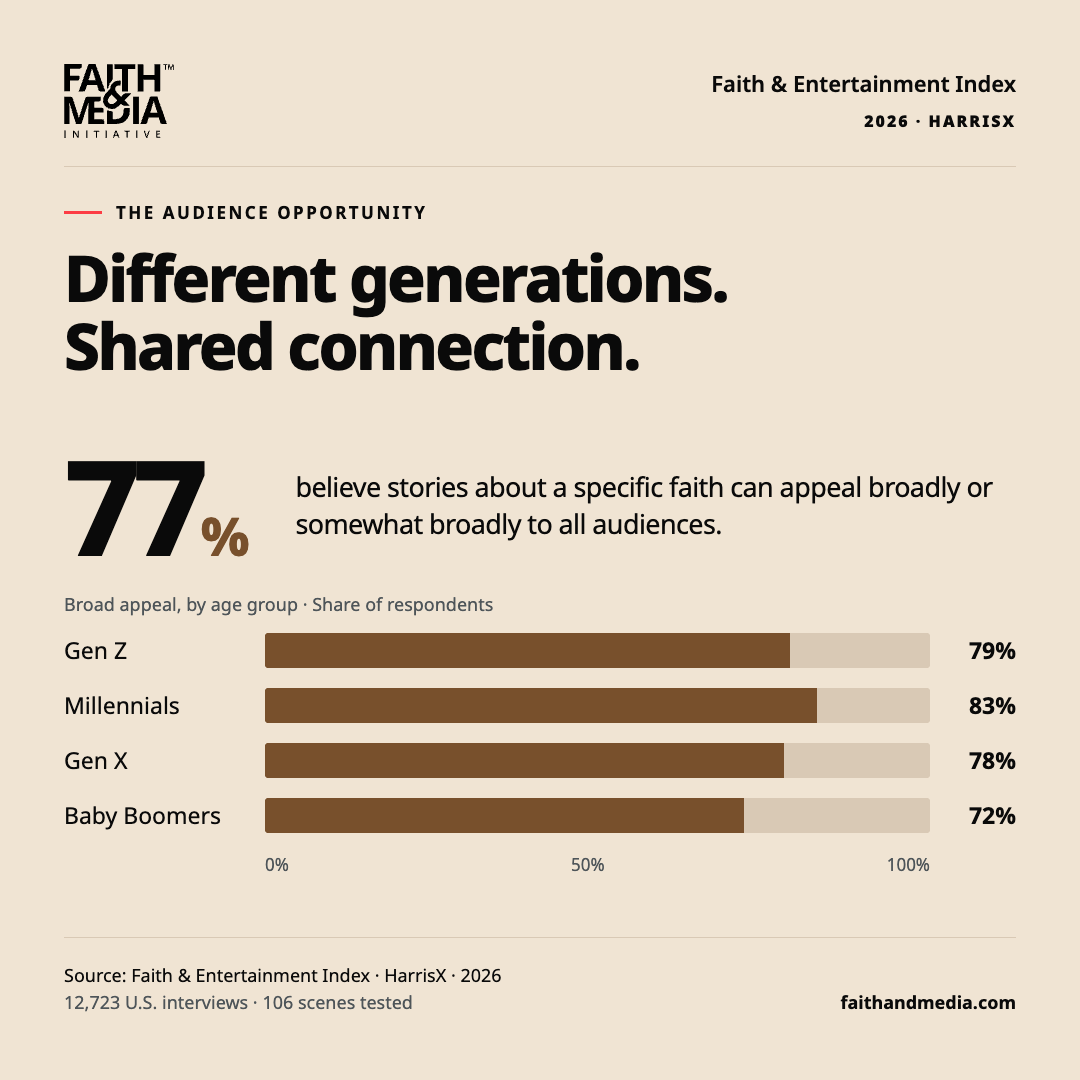
Faith in entertainment appeals across audiences.

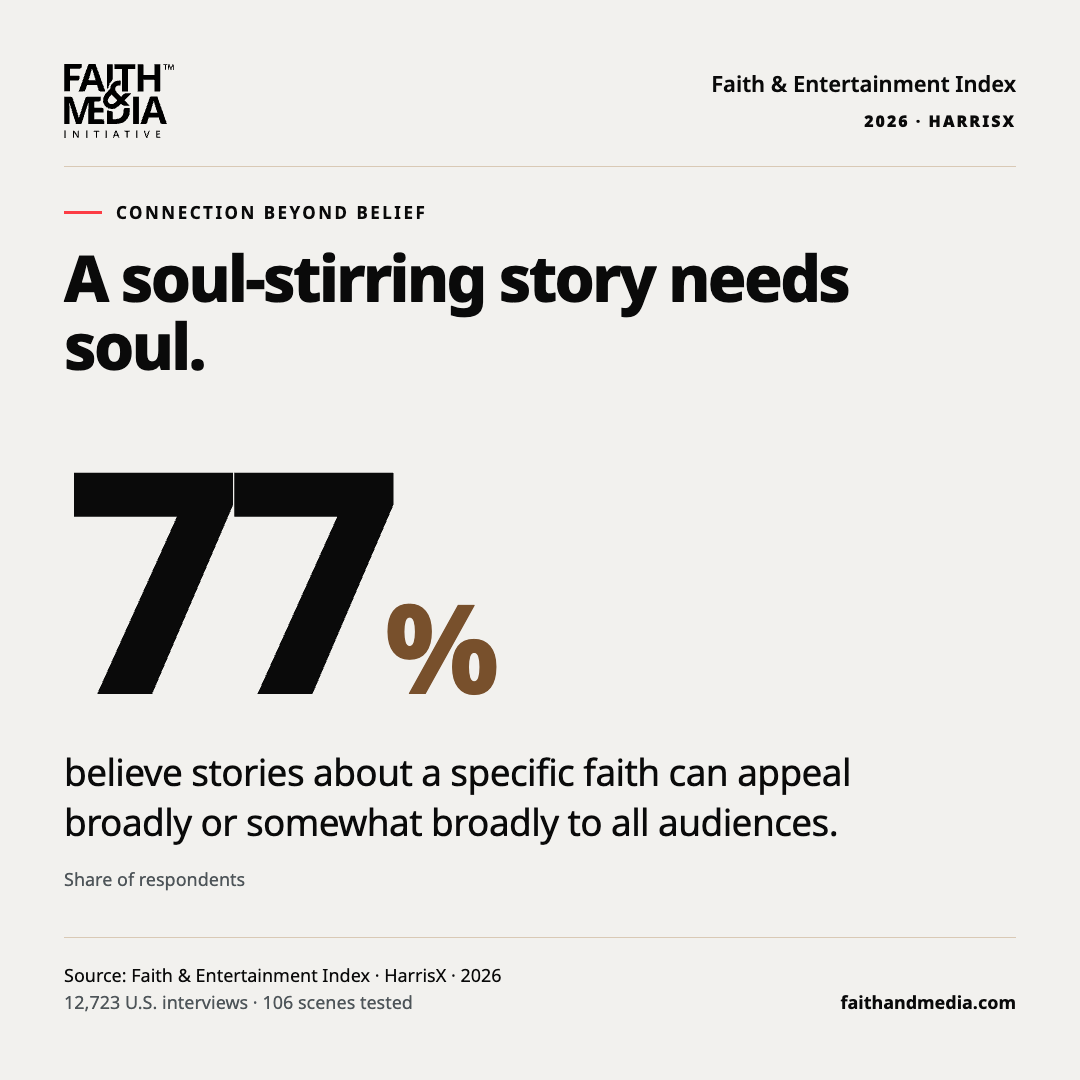
77%

Believe stories about a specific faith can have broad appeal.

A majority across ages, faiths, and political groups believe these stories can appeal broadly or somewhat broadly to all audiences.

Who believes these stories have broad appeal?

All entertainment consumers77%
Gen Z79%
Millennials83%
Gen X78%
Baby Boomers72%
Christian83%
Jewish78%
Muslim87%
Atheist / non-religious59%
Democrat75%
Republican82%
Independent / other73%
View data table
Who believes these stories have broad appeal?
Audience / measurePercent
All entertainment consumers77%
Gen Z79%
Millennials83%
Gen X78%
Baby Boomers72%
Christian83%
Jewish78%
Muslim87%
Atheist / non-religious59%
Democrat75%
Republican82%
Independent / other73%

2026 Faith & Entertainment Index · HarrisX

01 · Faith drives engagement

Seeing faith on screen deepens connection.

Before and after exposure to scenes.

Viewers found content with faith themes more appealing and more relatable after watching the selected clips, including viewers who were not religious.

Content with faith themes is more appealing

Before viewing scenes53%
After viewing scenes58%
View data table
Content with faith themes is more appealing
Audience / measurePercent
Before viewing scenes53%
After viewing scenes58%

+5 percentage points+15 points among atheists / agnostics

Content with faith themes is more relatable

Before viewing scenes53%
After viewing scenes61%
View data table
Content with faith themes is more relatable
Audience / measurePercent
Before viewing scenes53%
After viewing scenes61%

+8 percentage points+13 points among atheists / agnostics

2026 Faith & Entertainment Index · HarrisX

02 · Honesty drives authenticity

Emotion makes faith feel authentic.

6 of the top 10 scenes were emotional, reflective, and thought-provoking.

The three leading scenes share vulnerability and reflection. Audiences respond to emotional honesty and characters who grapple with belief.

The Pitt

Dr. Robby Thanks Whitaker

Key themes
  • Coping with tragedy
  • Professional endurance
  • Support and solidarity
Key tones
  • Reflective
  • Vulnerable
  • Empathetic

Viewer assessment

Portrays struggle and doubt77%
Deeply emotionally moving72%
Invites reflection69%
View data table
The Pitt: Dr. Robby Thanks Whitaker · Viewer assessment
Audience / measurePercent
Portrays struggle and doubt77%
Deeply emotionally moving72%
Invites reflection69%

Young Sheldon

Sheldon Convincing Mom to Believe in God

Key themes
  • Doubt and faith
  • Parental guilt / struggle
  • Divine design / fine-tuning
Key tones
  • Emotional
  • Pensive
  • Tender

Viewer assessment

Portrays struggle and doubt73%
Deeply emotionally moving74%
Invites reflection70%
View data table
Young Sheldon: Sheldon Convincing Mom to Believe in God · Viewer assessment
Audience / measurePercent
Portrays struggle and doubt73%
Deeply emotionally moving74%
Invites reflection70%

Nobody Wants This

I Love You

Key themes
  • Interfaith romance
  • Identity and belonging
  • Personal integrity
Key tones
  • Emotional
  • Pensive
  • Honest

Viewer assessment

Portrays struggle and doubt77%
Deeply emotionally moving74%
Invites reflection70%
View data table
Nobody Wants This: I Love You · Viewer assessment
Audience / measurePercent
Portrays struggle and doubt77%
Deeply emotionally moving74%
Invites reflection70%

2026 Faith & Entertainment Index · HarrisX

03 · Accessibility through familiarity

Faith resonates when it is lived through relationships.

Family, love, and shared everyday experiences.

Familiar human moments help audiences connect to faith. Relationships make the experience recognizable.

Depicts faith through everyday experience

Young Sheldon · Sheldon convinces his mom68%
Nobody Wants This · I Love You73%
View data table
Depicts faith through everyday experience
Audience / measurePercent
Young Sheldon · Sheldon convinces his mom68%
Nobody Wants This · I Love You73%
“Although we don’t know what has made mom question her faith, having Sheldon as her son and him telling her she is the best mom for him – it’s that warm feeling inside that the world needs right now.”
“The characters show sincerity and depth in their beliefs. That emotional honesty is what made it stand out as a good portrayal.”

2026 Faith & Entertainment Index · HarrisX

03 · Accessibility through familiarity

Humor builds connection when it is done with care.

92%

Open to seeing comedy or humor in the TV and movies they watch.

Comedy is the most sought-out theme. But the response to individual scenes depends on whether humor treats people and their faith respectfully.

The place of comedy

Open to comedy / humor in TV and film92%
Say respectful humor is important in faith portrayals66%
View data table
The place of comedy
Audience / measurePercent
Open to comedy / humor in TV and film92%
Say respectful humor is important in faith portrayals66%

Agree the scene uses humor respectfully

#6 · Nobody Wants This — Noah’s Sermon69%
#22 · Young Sheldon — Exploring Religion70%
#105 · Broad City — Yom Kippur48%
#106 · Mo — Nicolas’ Mom’s Prayer41%
View data table
Agree the scene uses humor respectfully
Audience / measurePercent
#6 · Nobody Wants This — Noah’s Sermon69%
#22 · Young Sheldon — Exploring Religion70%
#105 · Broad City — Yom Kippur48%
#106 · Mo — Nicolas’ Mom’s Prayer41%
“When they threw in the random crypto joke… you can kind of chuckle a little bit… loosen people up and then… they’ll be more receptive.”
“It never got past the stereotypical assumptions that are typically associated with various religions.”

2026 Faith & Entertainment Index · HarrisX

Across faith traditions

Different beliefs. Shared connection.

The story and experience mattered more than a specific faith tradition. Explore each audience’s ten highest-ranked scenes.

Christian

  1. Hacksaw RidgePlead Guilty
  2. The PittDr. Robby Thanks Whittaker
  3. Young SheldonSheldon Convincing His Mom
  4. Nobody Wants ThisNoah’s Sermon
  5. Hacksaw RidgeI Can’t Touch a Gun
  6. Hacksaw RidgeDesmond Asks God for Strength
  7. Nobody Wants ThisI Love You
  8. Hacksaw RidgeDesmond Speaks to Court
  9. God’s Not DeadSin Is Like a Jail Cell
  10. The West WingParable Conversation

Jewish

  1. The PittDr. Robby Thanks Whittaker
  2. Life of PiPi’s Religious Exploration
  3. Nobody Wants ThisI Love You
  4. Orange Is the New BlackCindy Wants to Convert
  5. ConclaveCardinal Benitez’s Revelation
  6. Midnight MassSheriff Hassan's Monologue on Dignity
  7. Nobody Wants ThisNoah’s Sermon
  8. HomelandSaul on Politics & Religion
  9. Hacksaw RidgeDesmond Asks God for Strength
  10. Orange Is the New BlackNicky’s Bat Mitzvah

Muslim

  1. King RichardFamily Dinner
  2. Nobody Wants ThisProgressive Rabbi Neil
  3. Hacksaw RidgePlead Guilty
  4. Life of PiPi’s Search for Religion
  5. Midnight MassSheriff Hassan's Monologue on Dignity
  6. Ramy“Islam Is Like an Orange”
  7. Young SheldonExploring Religion
  8. Young SheldonSheldon Convincing His Mom
  9. RamyRamy’s Family Meets Zainab’s
  10. The PittDr. Robby Thanks Whittaker

Atheists/ Agnostics

  1. Young SheldonSheldon Convincing His Mom
  2. The PittDr. Robby Thanks Whittaker
  3. CocoMiguel Into Land of the Dead
  4. The PittWhittaker Finds Dr. Robby
  5. Hacksaw RidgeDesmond Asks God for Strength
  6. The West WingParable Conversation
  7. Orange Is the New BlackCindy Wants to Convert
  8. Nobody Wants ThisNoah’s Sermon
  9. CocoDía de los Muertos
  10. Nobody Wants ThisI Love You

Explore the full scene index

Tools for storytelling

Familiar moments make faith accessible.

Tools and plot devices that help ground audiences.

01

Family & intergenerational relationships

  • Young Sheldon · Sheldon Convincing His Mom to Believe in God
  • The Big Sick · Family Argument
02

Love & romance

  • Nobody Wants This · I Love You
  • This Is Us · Hospital Chapel
03

Respectful humor

  • The Big Sick · Hospital Lunch
  • Broad City · Yom Kippur
04

Warmth & lightness

  • Coco · Miguel Crosses Into the Land of the Dead
  • Nobody Wants This · Noah’s Sermon

What this means for creators

A small set of proven story moves.

Home runs

  • Is entertaining
  • Respectful humor
  • Makes you reflect
  • Is relatable
  • Accurate depiction
  • Emotionally moving
  • Is easy to understand
  • Authentic depiction
  • Made for people like me
  • Weaves naturally

High-potential, overlooked

  • Layered, complex characters
  • Appeal to people with no faith
  • Teaches you something new about faith
  • Appeal to people of a different faith

What the research makes clear

Faith resonates most
when it feels human.

Real people. Real stakes. Audiences respond to faith when it shows up in everyday moments—doubt, love, grief, courage.

When belief is woven naturally into honest characters and lived experience, it doesn’t limit who’s watching. It widens the circle.

Done right, faith doesn’t just entertain. It invites reflection. Builds empathy. And connects people across belief lines.

Explore Faith & Media Connect

A scene from Life of Pi
Life of Pi (2012), 20th Century Fox.

The complete picture

Keep exploring.

Download the full 71-page report, its complete rankings, and shareable social graphics.
Download full report

Social media assets

Sources and editorial notes

Source: FAMI’s 2026 Faith & Entertainment Index and its downloadable HarrisX report.

The report supplies the exact interview count (12,723), scene count (106), and the correct “more relatable” label for the second before/after comparison. The web page repeats the “more appealing” label.

For Nobody Wants This · I Love You, Muslim rank #43 follows report p. 42; the source webpage says #87. The source embeds a Hacksaw Ridge clip for Noah’s Sermon; this page supplies the Netflix episode and timestamp instead.

Repeated, mismatched social commentary on the source page is not attributed to unrelated scenes here. Social listening is included where the report supports the scene association. The Pitt’s coding analysis follows report p. 39 rather than the unrelated awards list shown on the webpage.

In partnership with HarrisX.

Scene video

Watch on YouTube

Millicent RoneSimran Jeet SinghLiz KinekeOmar Al BusaidyChristine SwansonCarolyn ChenSue ObeidiDavid MorganBrooke ZauggRabbi Elan BabchuckEboo PatelStephanie Okereke LinusAsma T. UddinMichael WakelinKashif Shaikh

Join the Coalition

Bring your experience, ideas and perspective. Tell us why you’d like to help tell a more authentic story about faith.

All fields are required unless marked optional.