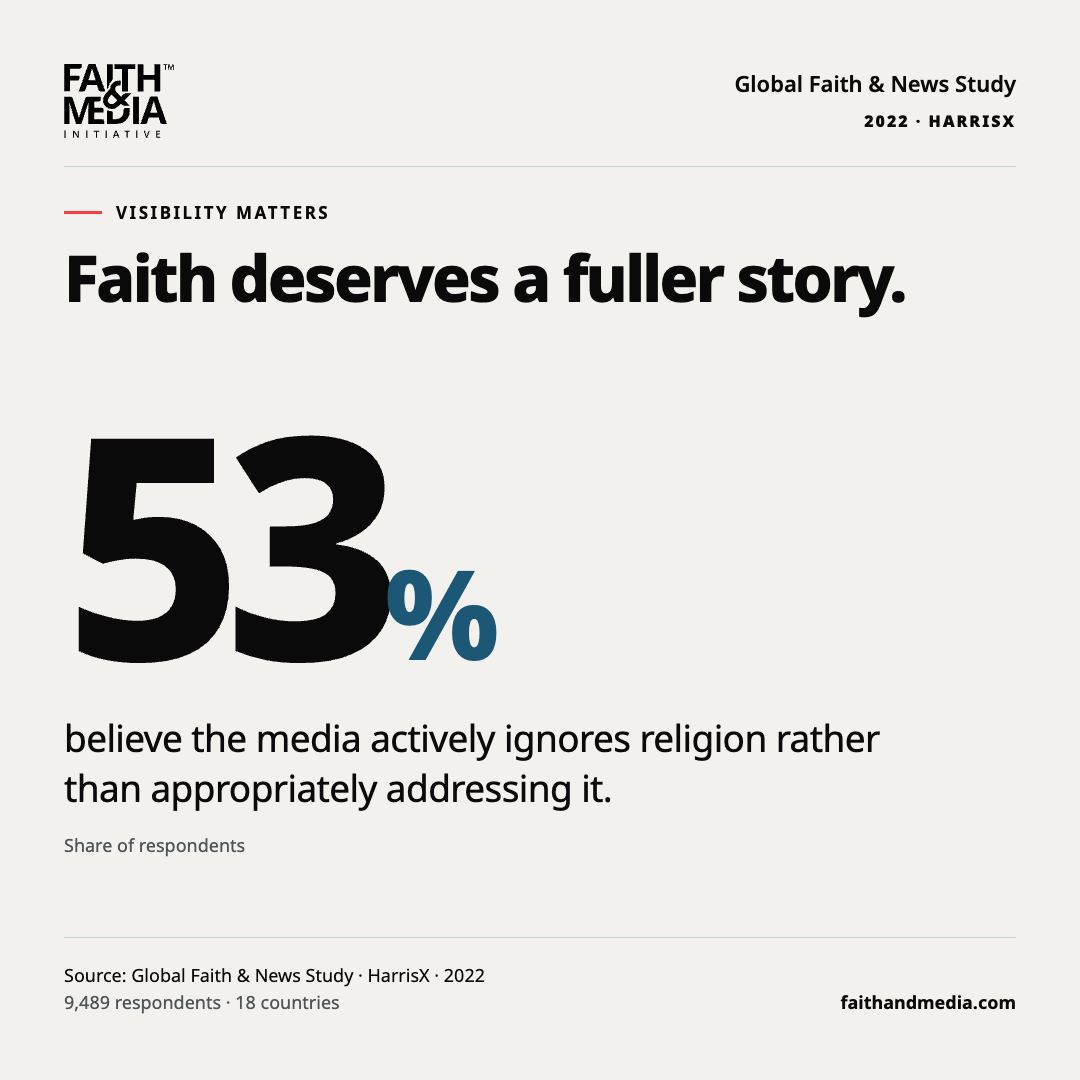
53%
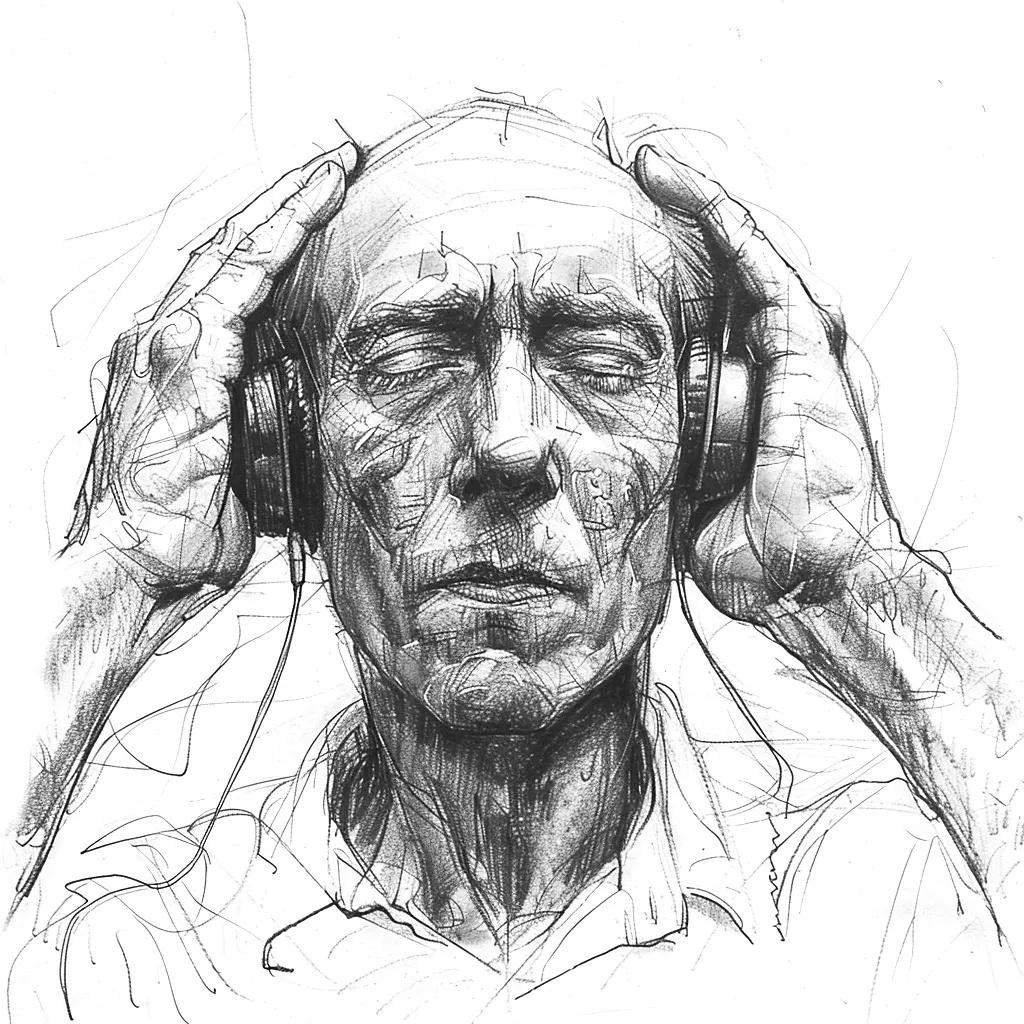
Missing from the story
believe the media actively ignores religion rather than appropriately addressing it.
A fuller picture.
A better-informed world.
A groundbreaking study of attitudes and perceptions regarding faith and religion in news media.
The global study
In September 2022, HarrisX released the Global Faith & News Study, a comprehensive report revealing attitudes and perceptions on faith in the media from the perspectives of newsroom decision makers as well as the general population. The study was undertaken to better understand the relationship between media, religion and faith, the impact that media depictions of faith have within society, and to determine opportunities for beneficial outcomes in society.
Conducted by Harris X in collaboration with the Faith and Media Initiative, a non-profit organization working towards balanced representation of faith in journalism and entertainment, the study surveyed 9,489 people in 5 languages across the major world religions in 18 countries. In addition, 30 in-depth interviews with journalists and editors were conducted across the same geographic footprint.
Explore the methodologyThe voice of people
Global Faith & News Study · HarrisX · 2022
Behind the research
Hear why faith belongs in the conversation.
01 · The voice of people
01 / 06 · The problem
How faith is covered can shape both public understanding and people’s willingness to share their beliefs.
believe the media actively ignores religion rather than appropriately addressing it.
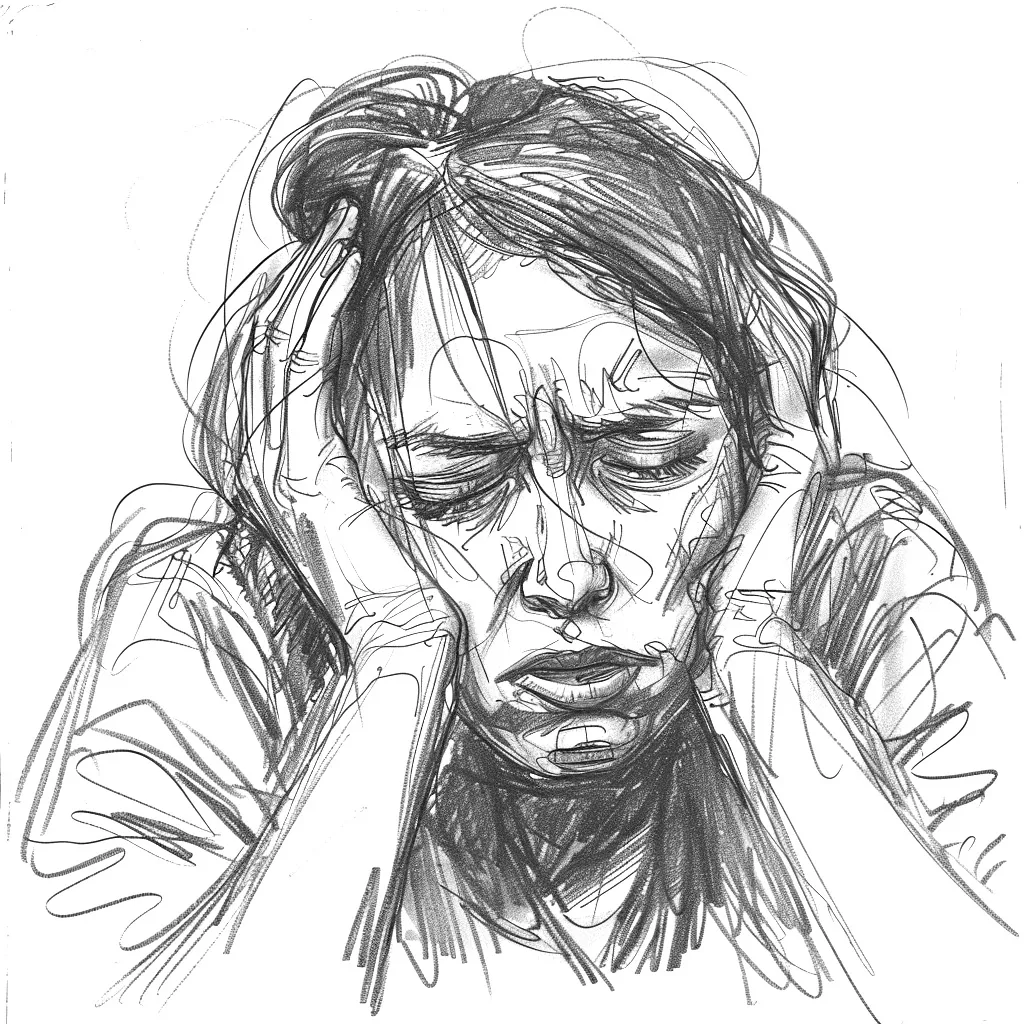
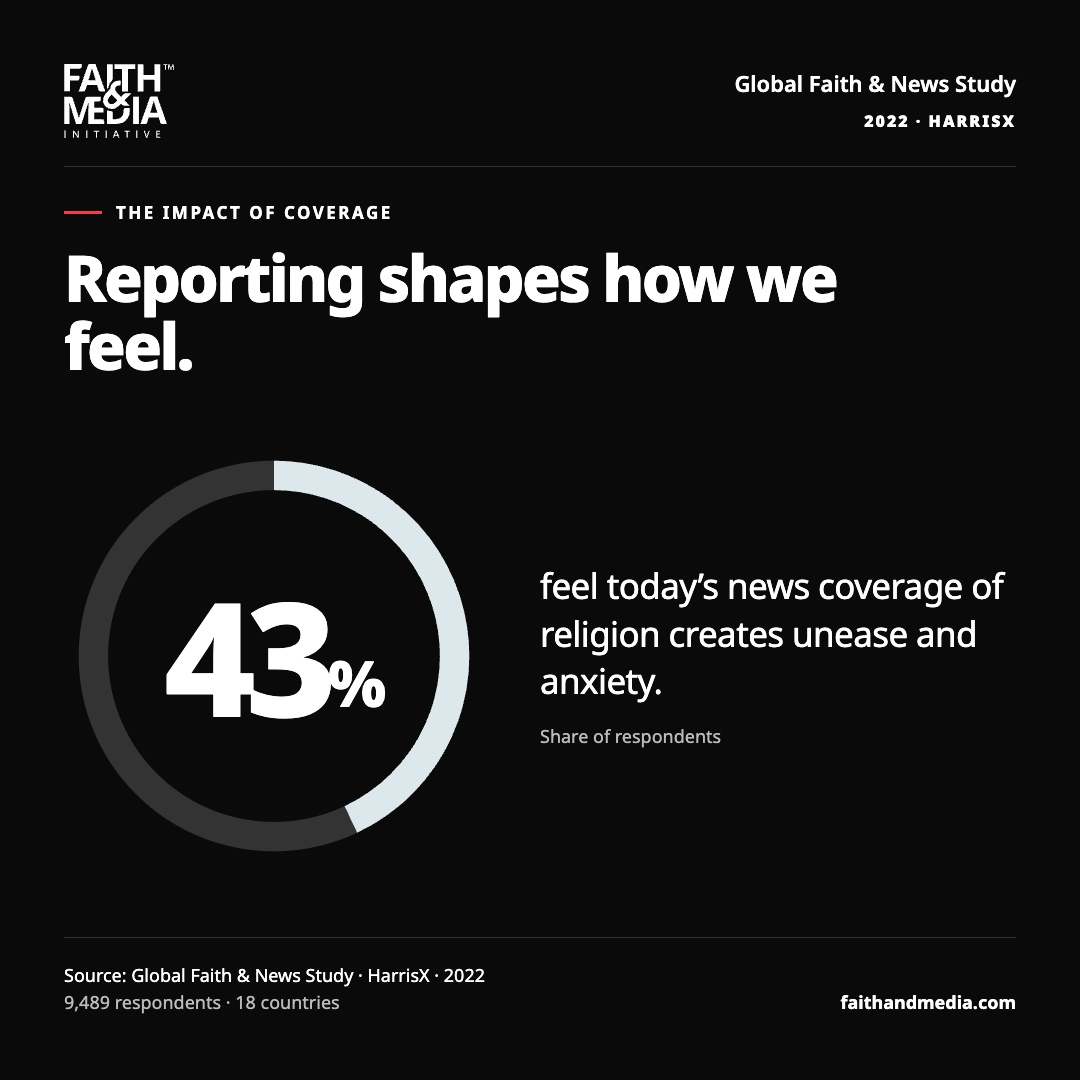
feel today’s news coverage of religion creates unease and anxiety (even more so in secular nations).
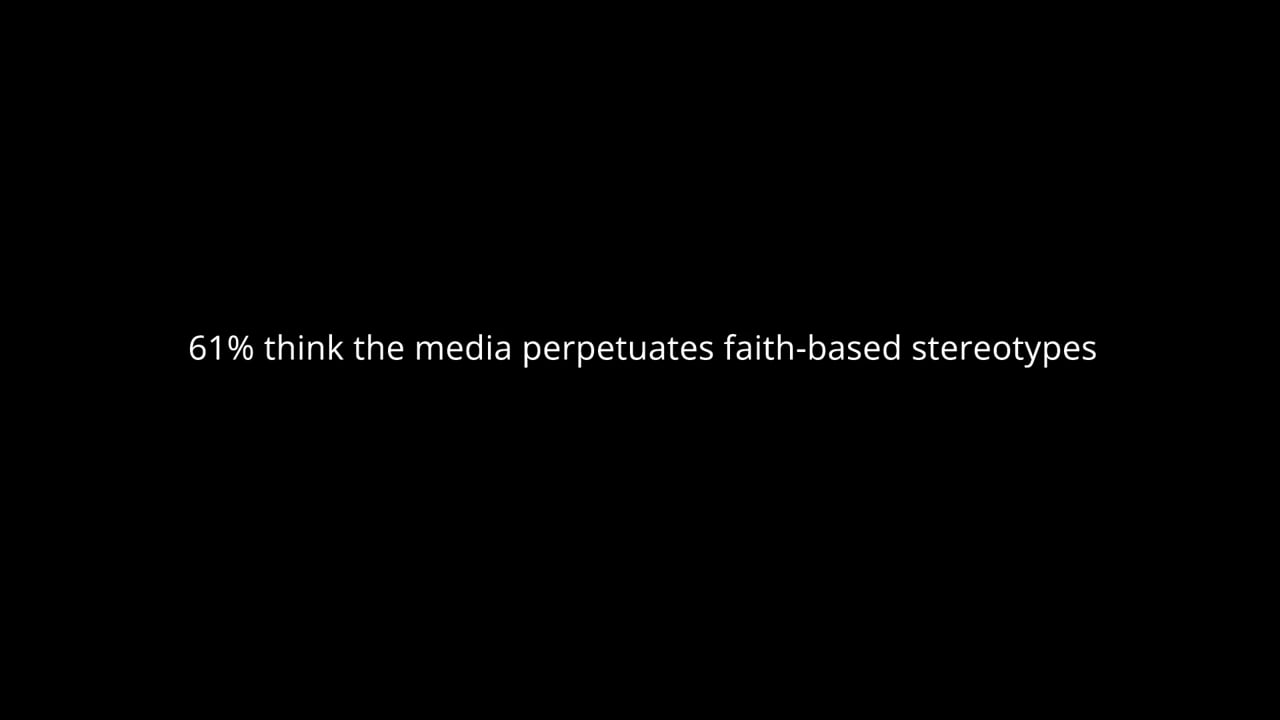
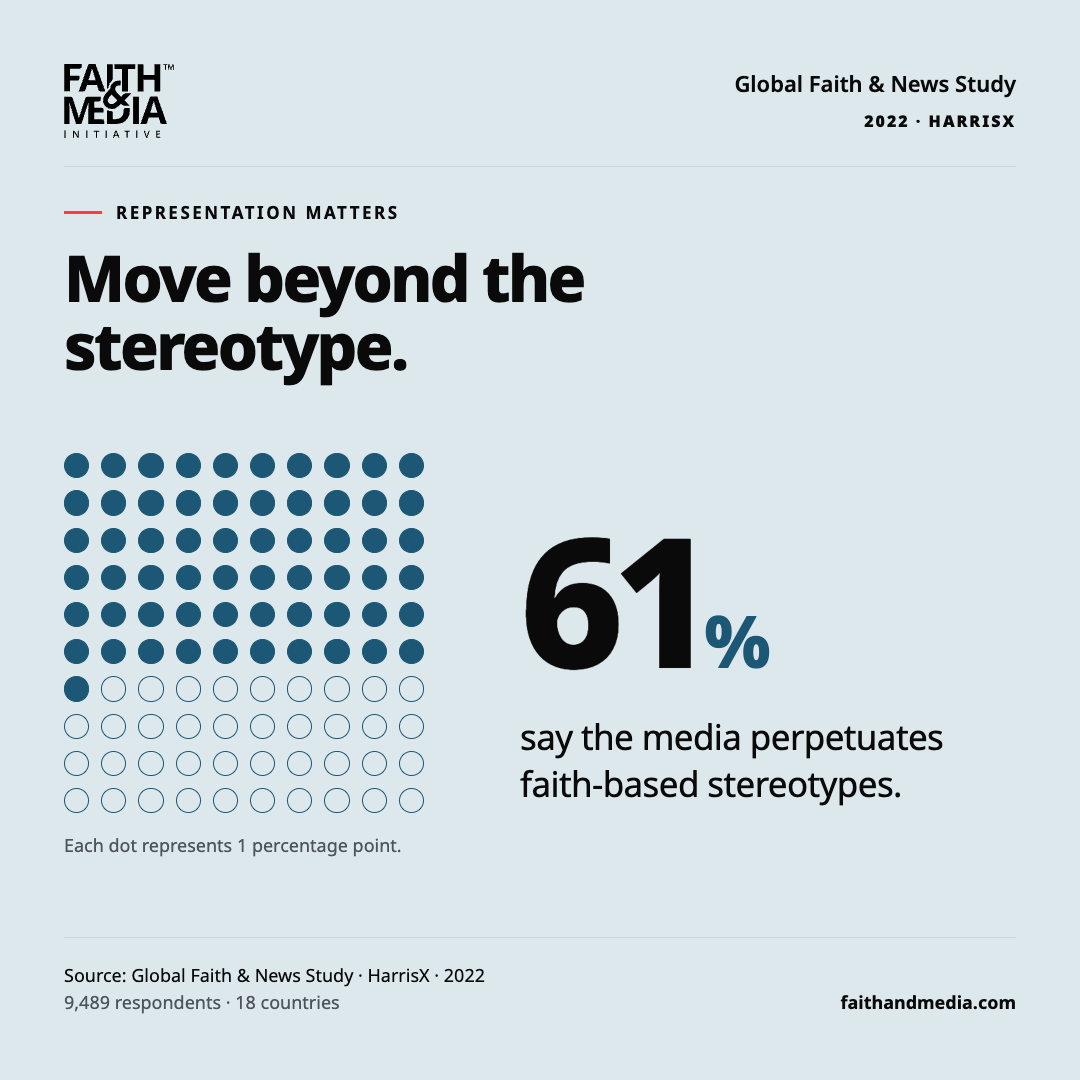
say the media perpetuates faith-based stereotypes.
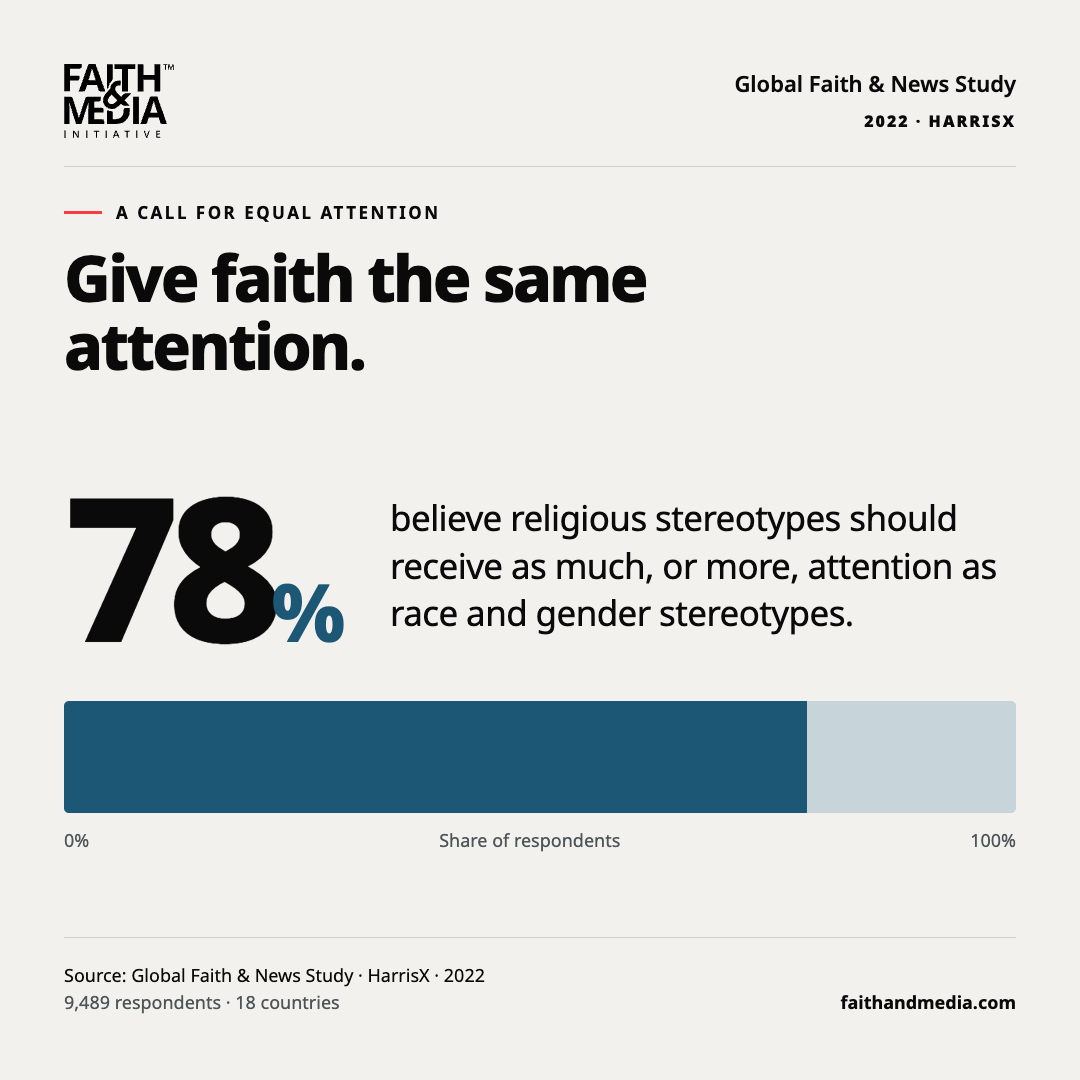
believe religious stereotypes should get as much, or more, attention as race and gender stereotypes.
Global Faith & News Study · HarrisX · September 2022. Online survey of 9,489 adults in 18 countries, August 26 – September 9, 2022.
02 / 06 · Beyond the newsroom
More than
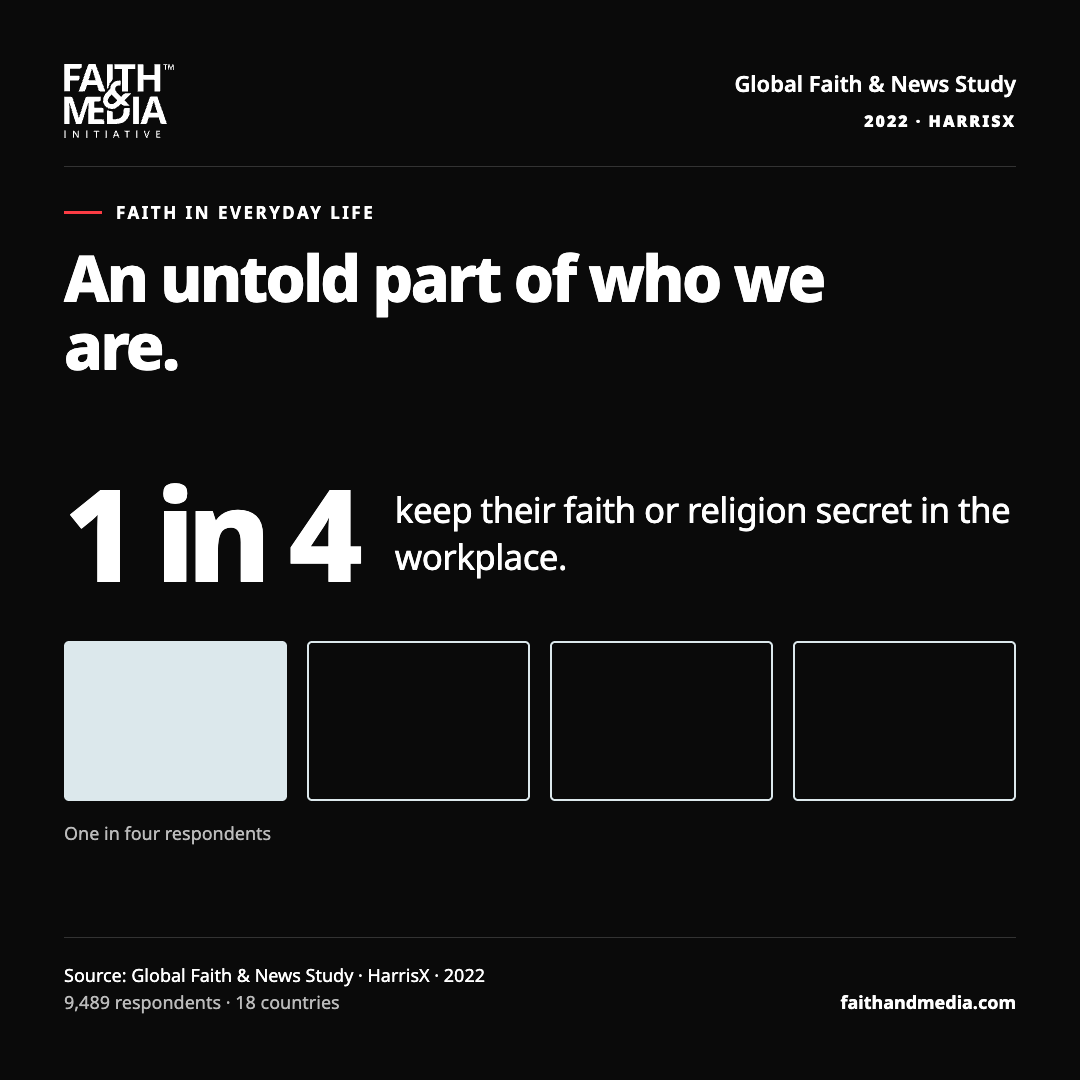
keep their faith or religion secret in the workplace.
The study also revealed ways in which the media’s coverage of religion is intrinsically linked to how people feel about expressing their faith in the workplace and beyond. More than 1 in 4 respondents globally have kept their faith or religion secret in the workplace (including 33% in the US, 38% in Australia, 49% in China, 47% in Singapore and 39% in India), mainly driven by the feeling it is not relevant or appropriate in the workplace, concern about tension with colleagues, and fear of harming their work prospects.
Five country figures published on the study webpage. The global finding is described as “more than 1 in 4.”
| Audience / country | Respondents |
|---|---|
| United States | 33% |
| Australia | 38% |
| China | 49% |
| Singapore | 47% |
| India | 39% |
Global Faith & News Study · HarrisX · September 2022. Online survey of 9,489 adults in 18 countries, August 26 – September 9, 2022.
03 / 06 · The opportunity
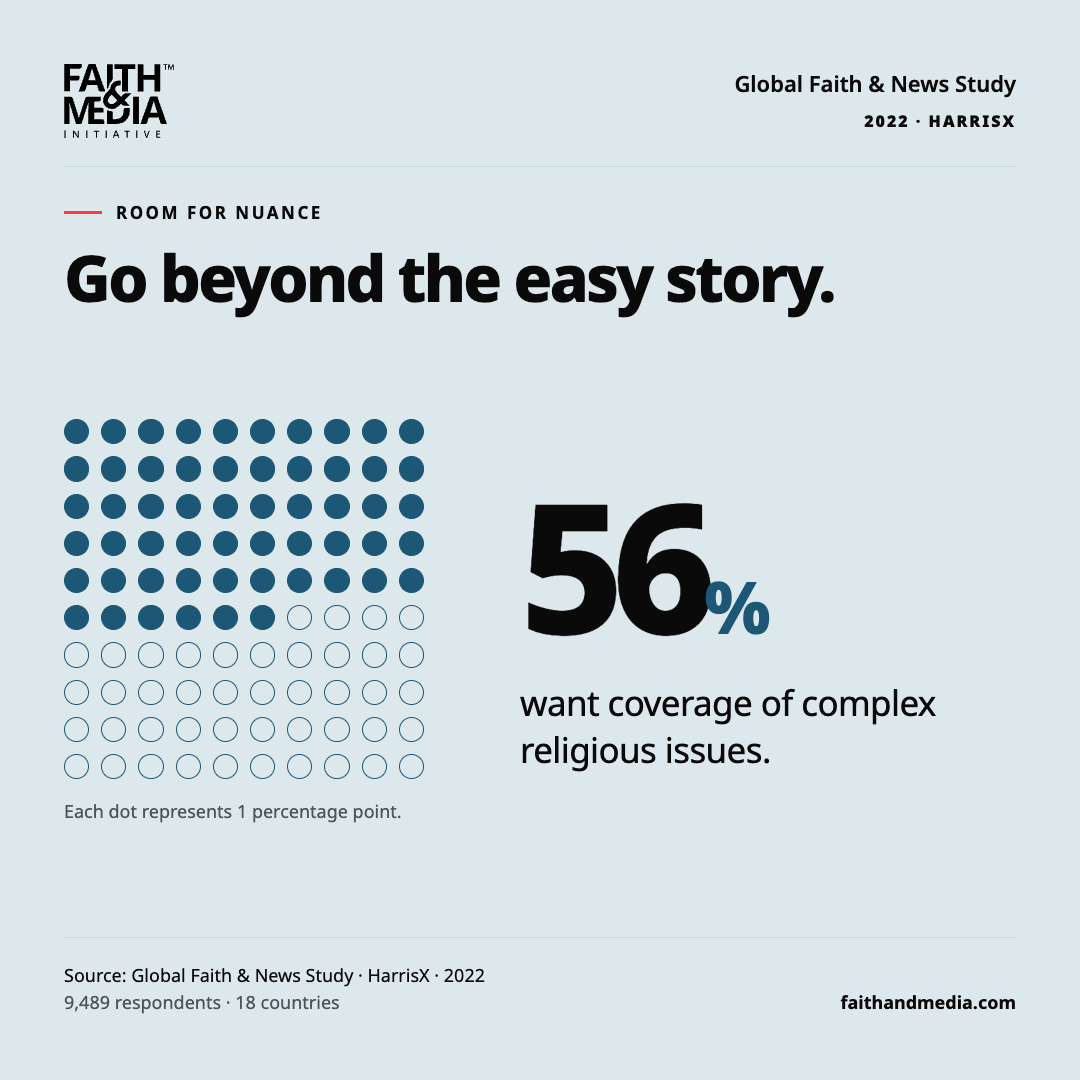
Audiences seek deeper coverage of complex issues, more faith diversity and coverage that challenges stereotypes.
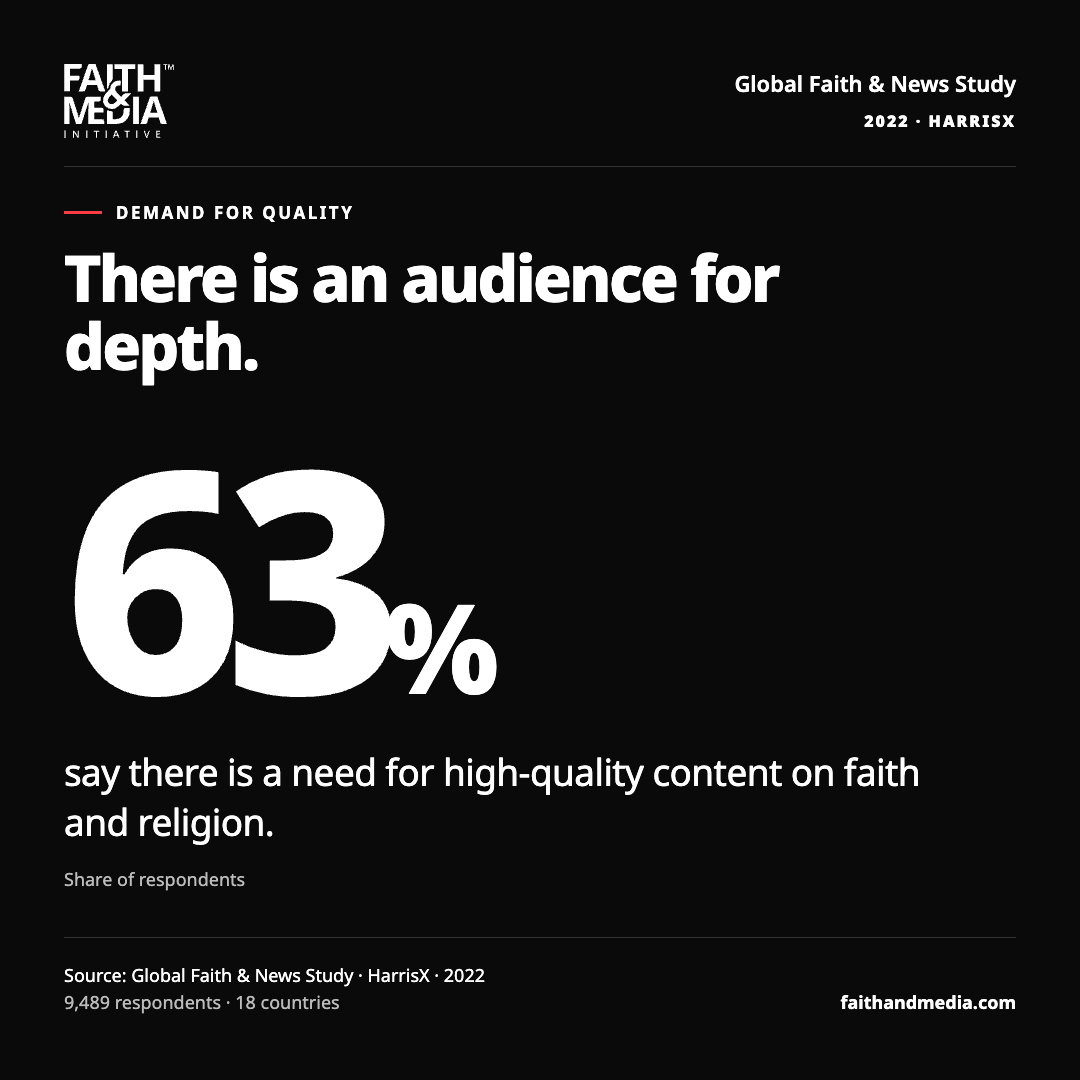
say there is a need for high quality content on faith and religion.
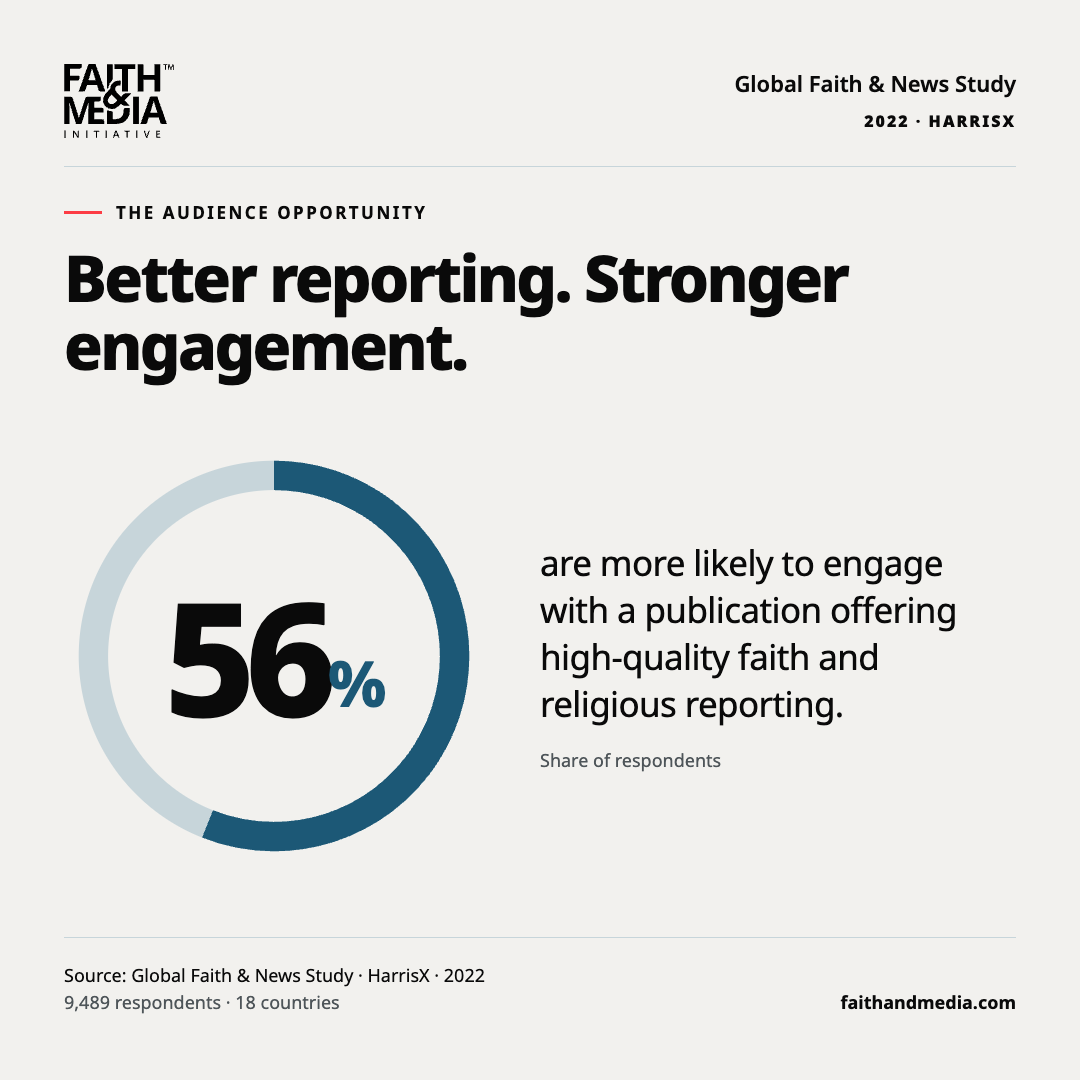
are more likely to engage with a publication with high-quality faith and religious reporting.

want coverage of complex religious issues.
Global Faith & News Study · HarrisX · September 2022. Online survey of 9,489 adults in 18 countries, August 26 – September 9, 2022.
04 / 06 · Better sources
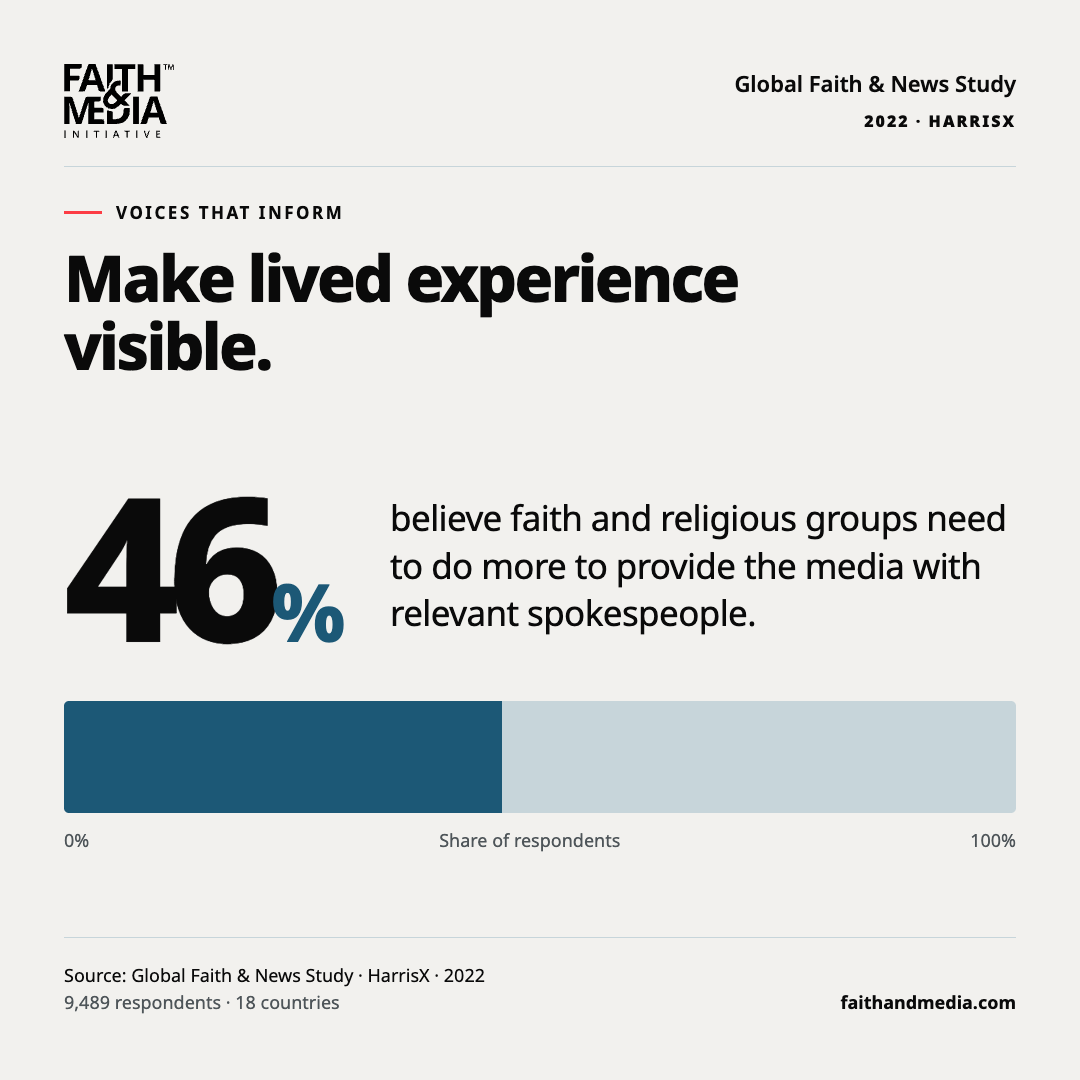
46%
believe faith and religious groups need to do more to provide the media with spokespeople, particularly people with lived experience.
84% say groups should provide more spokespeople or about the same level of representation.
The 84% combines “more” (46%) and “about the same” (38%). It is a broader measure than the call to do more.
| Audience / country | More | About the same | Less |
|---|---|---|---|
| Global | 46% | 38% | 16% |
| Highly faithful / religious | 55% | 31% | 14% |
| Middle of the way | 38% | 47% | 15% |
| Secular | 43% | 39% | 18% |
Country groups follow the study’s faith index. See group definitions.
Global Faith & News Study · HarrisX · September 2022. Online survey of 9,489 adults in 18 countries, August 26 – September 9, 2022.
FMI10A: Do you think faith and religious groups need to do more, less or about the same to provide the media with a relevant spokesperson?
05 / 06 · A fuller perspective
59%
rate diverse faith and religious perspectives as important — the report’s top three ratings.
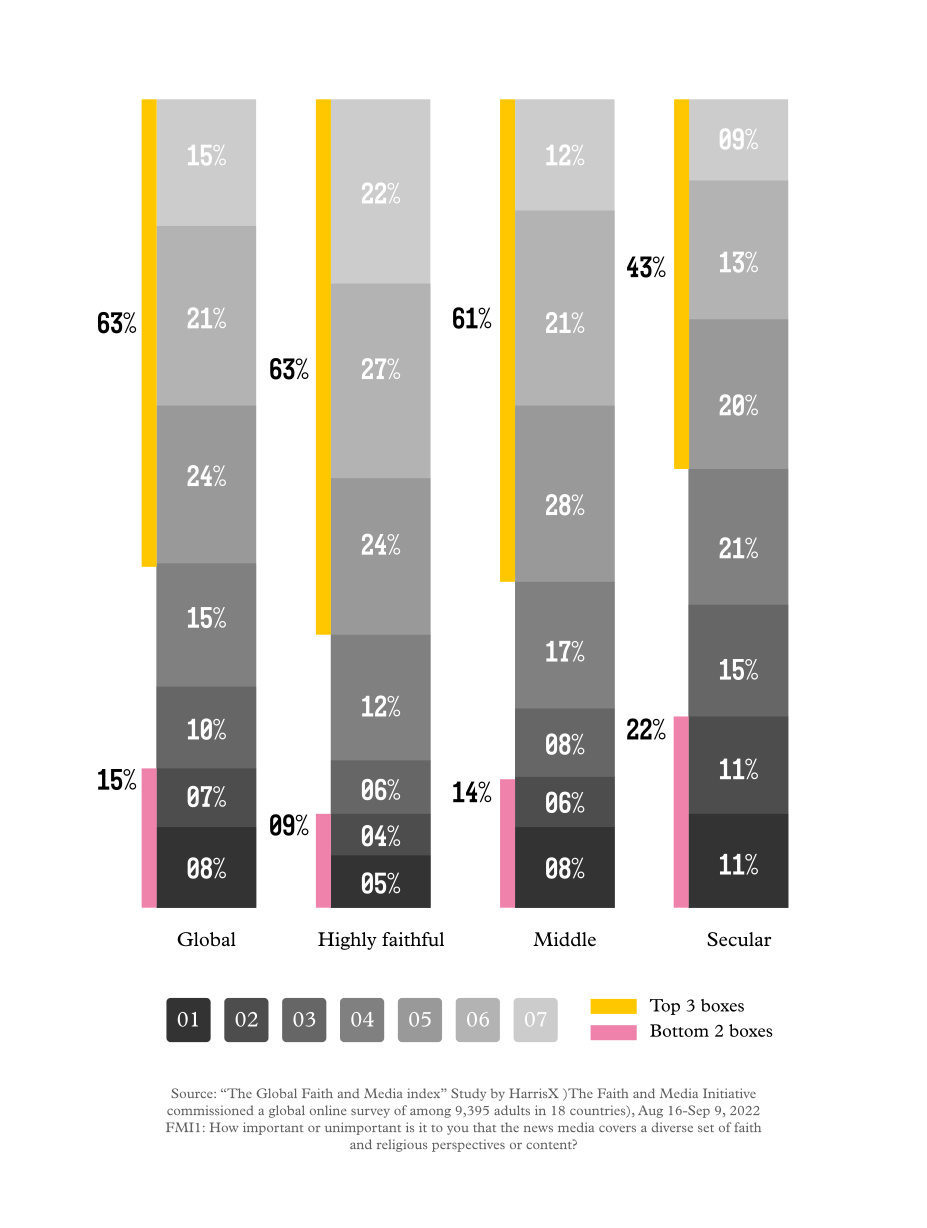
There is strong agreement that the news media needs to cover a diverse set of faith and religious perspectives or content.
The webpage says 63%; the downloadable report gives 59%. This chart follows the report. Compare the published sources.
Important · ratings 5–7 on a seven-point scale
Each bar uses the same 0–100% scale. Country groups follow the study’s faith index. See group definitions.
| Audience | Top 3 ratings | Bottom 2 ratings | Rating 1 | Rating 2 | Rating 3 | Rating 4 | Rating 5 | Rating 6 | Rating 7 |
|---|---|---|---|---|---|---|---|---|---|
| Global | 59% | 15% | 8% | 7% | 10% | 17% | 24% | 21% | 15% |
| Highly faithful / religious | 74% | 9% | 5% | 4% | 6% | 12% | 24% | 27% | 22% |
| Middle of the way | 61% | 14% | 8% | 6% | 8% | 17% | 28% | 21% | 12% |
| Secular | 43% | 22% | 11% | 10% | 14% | 21% | 20% | 13% | 9% |
Percentages are shown as published. Rounded response categories may not sum to 100% or exactly match the reported combined percentages.
The source webpage states 63% for diverse faith perspectives. The downloadable report (pages 4, 14 and 23) reports 59% globally, and 74% for the highly faithful/religious group. This page uses the report for the rebuilt chart and preserves the original web graphic for comparison.
The original web graphic also differs from the report in some individual response percentages.
| Audience | Top 3 ratings | Bottom 2 ratings | Rating 1 | Rating 2 | Rating 3 | Rating 4 | Rating 5 | Rating 6 | Rating 7 |
|---|---|---|---|---|---|---|---|---|---|
| Global | 63% | 15% | 8% | 7% | 10% | 15% | 24% | 21% | 15% |
| Highly faithful / religious | 63% | 9% | 5% | 4% | 6% | 12% | 24% | 27% | 22% |
| Middle of the way | 61% | 14% | 8% | 6% | 8% | 17% | 28% | 21% | 12% |
| Secular | 43% | 22% | 11% | 11% | 15% | 21% | 20% | 13% | 9% |
Global Faith & News Study · HarrisX · September 2022. Online survey of 9,489 adults in 18 countries, August 26 – September 9, 2022.
FMI1: How important or unimportant is it to you that the news media covers a diverse set of faith and religious perspectives or content?
06 / 06 · An audience already listening
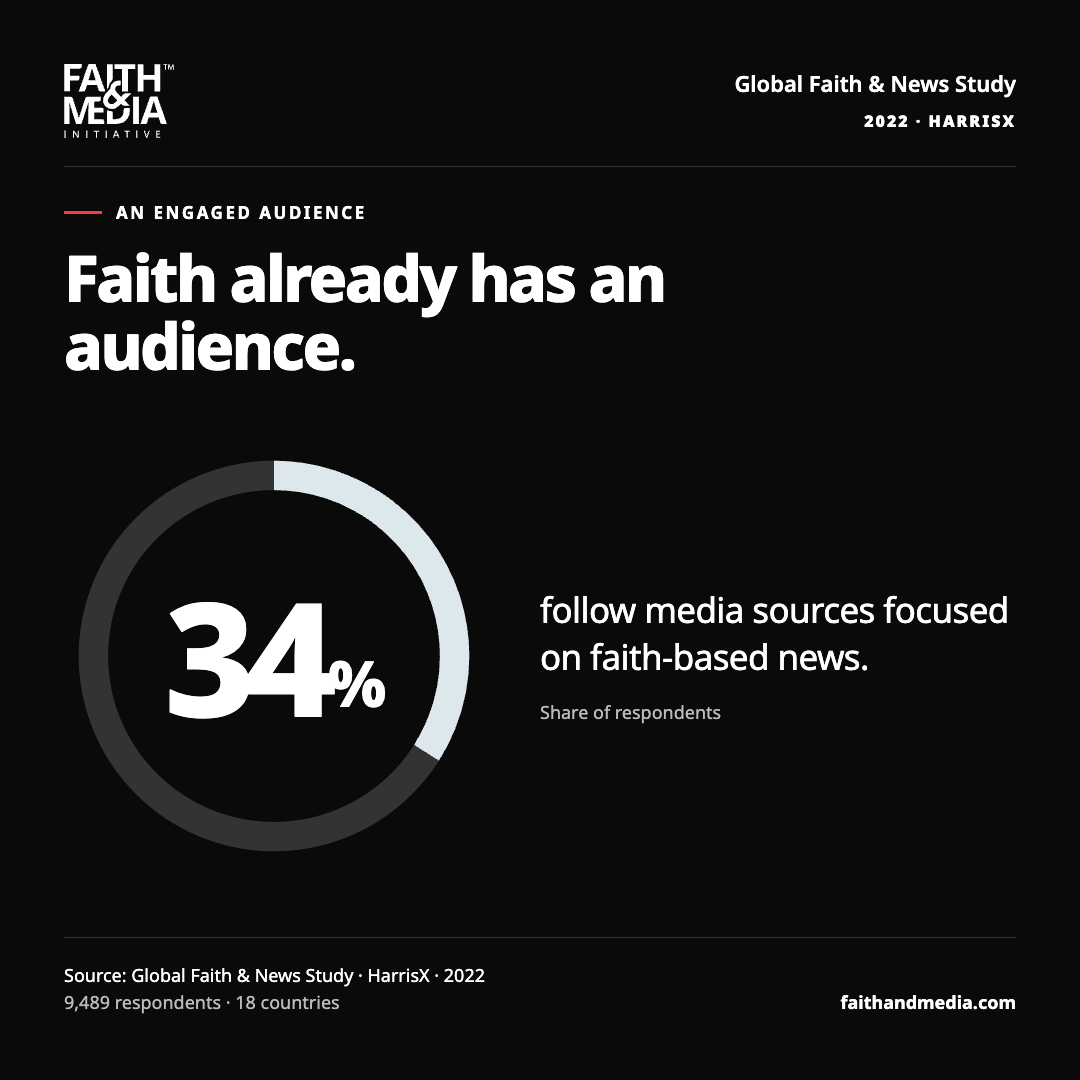
Around
people follow media sources focused on faith-based news (47% in highly religious countries).
The report gives the global figure as 34%, rising to 47% in highly faithful/religious countries.
| Audience / country | Follow faith-based news |
|---|---|
| Global | 34% |
| Highly faithful / religious | 47% |
| Middle of the way | 26% |
| Secular | 26% |
See country group definitions.
Global Faith & News Study · HarrisX · September 2022. Online survey of 9,489 adults in 18 countries, August 26 – September 9, 2022.
FMT5: Do you follow any media sources that are focused on faith-based news?
02 · The media point-of-view
There is universal agreement among members of the media that editorial coverage on faith and religion has become marginalized due to newsroom dynamics.
Insights from the study’s in-depth media interviews.
Media respondents said reduced budgets have led to a lack of specialist journalists, leaving generalists to cover topics – including faith and religion.
“In Mexico it's really focused on covering political news and covering crime…sometimes it's really selective the moments when we talk about religion.”
“Religion is just peripheral to be honest. My perception is that it kind of crops up in these rather slightly kind of marginal corners of journalism.”
Media interviewees described a general fear around covering religion. In an era when religion has become increasingly politicized, news coverage, often at speed, brings with it the tacit acceptance that it’s impossible to cover the topic with a level of nuance and sensitivity given the time and resource available.
“I don't cover such stories, because you never know when you are offending someone.”
“Religion is so personal; I'm doing a job for public good. Why do I have to explain something about religion? I mean, reader doesn't need that. For that they can just download the Bible or Quran and read it.”
Respondents in all regions noted that the newsroom rarely represents the plurality of religions views in society. Among journalists with a strong faith background, there is a feeling that they might be negatively judged if they covered stories relating to their beliefs out of concern it would raise questions about their impartiality and risk damaging their reputations.
“In our team right now, we do not have any person who is a Muslim or any person who is another faith …not that we hate them, or we don't want to recruit them. But it's just because they are not people who apply for jobs.”
“I was asked to write a piece because I was the only Muslim on staff.”
There is consensus that faith and religion are not seen as a driver for reader engagement. Editors almost never encourage stories in the area unless they correspond to a narrative of controversy, dissent, or scandal. This runs counter to the findings which suggest that 63% of people globally say that high-quality content on faith and religion is needed in their respective counties.
“I get feedback every week about how my last story performed. This sets me a target for what I do this week.”
“The news that creates traction is crime and politics …It is made clear to me from my editor that these are the paper’s priorities, and they have numbers to back them up.”
Stereotyping was identified as an issue, with a lack of diverse media sources and spokespeople, perpetuating the problem. Religion is frequently positioned as a conversative or extreme force in coverage, which creates a tendency to seek outspoken dogmatic spokespeople over more middle-ground religious observers with mainstream views.
“We are unintentionally creating a stigma or a bad stereotype, particularly on our Muslim brothers and sisters in the Philippines.”
"It's usually covered as a feature of conservative politics. "
03 · A way forward
Better representation, more media training, and a stronger relationship.
The insights gained from the HarrisX study underscore an opportunity for closer alignment between faith organizations and newsrooms to ensure more accurate representation in the media. Alongside increasing diversity within newsrooms, greater access to a diverse range of spokespeople is needed to break the oft-repeated cycle of media turning to outspoken, potentially divisive spokespeople who fail to represent the opinions and experience of the majority of the population.
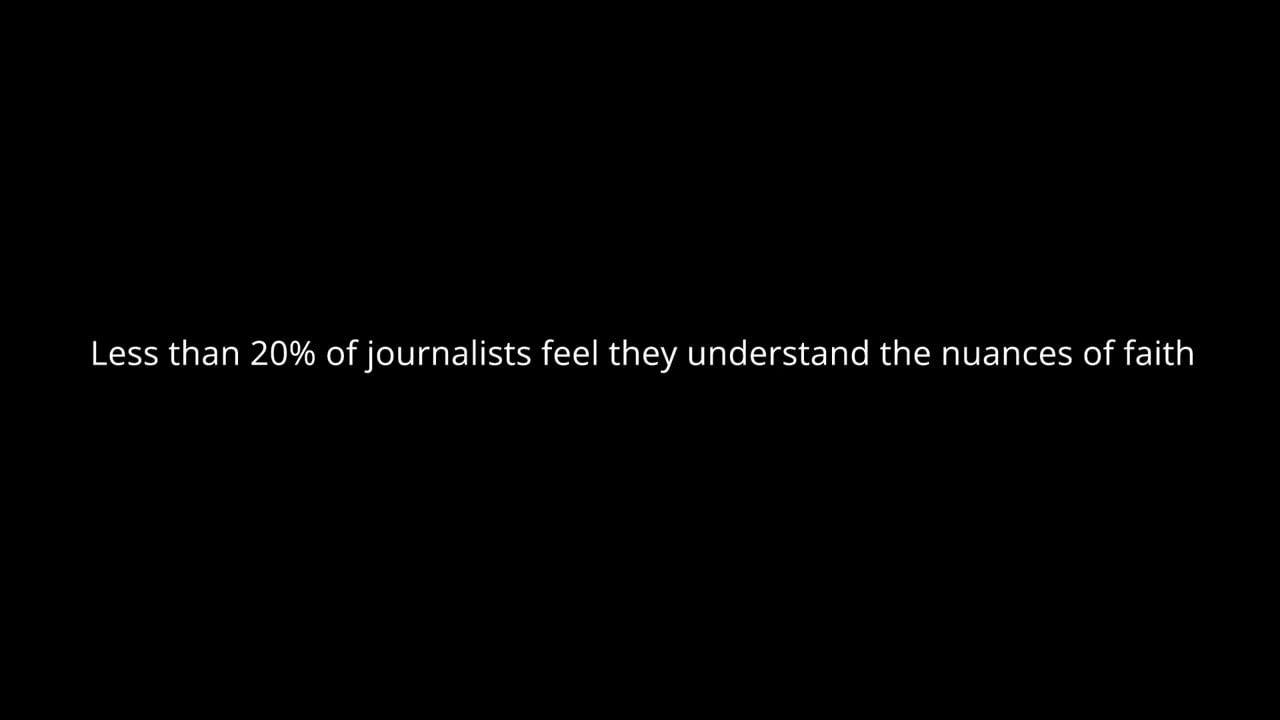
Amongst respondents, there was strong agreement (84%) that faith and religious groups need to provide the media with spokespeople, particularly people with lived experience. In order to encourage fair and balanced coverage (and avoid negative stereotyping), feedback also indicates that more training is needed in newsrooms to ensure that reporters feel equipped to handle the nuances that unbiased religious reporting requires. It is clear from the findings that inaccurate representation of faith in media not only negatively impacts media and religious institutions, but also erodes trust and confidence in the audiences and members that each group seeks to serve.
Drawing on the global feedback and responses from thousands of people around the world, the first-ever study succeeded in identifying many of the root causes, factors, and challenges behind inaccurate representation of faith and religion within journalism. Insights revealed by the study also outlined key areas of opportunity that, if implemented, have the potential to create mutually beneficial outcomes for both media organizations and the audiences they serve around the world.
The 84% referenced here combines “more” and “about the same” in the spokesperson question. Explore this finding.
Explore Faith & Media ConnectThe foundation
Published September 2022
Survey fieldwork: August 26 – September 9, 2022
9,489 online interviews across 18 countries and five languages, covering the major world religions.
| Country | Respondents |
|---|---|
| United States | 1,560 |
| Canada | 1,030 |
| United Kingdom | 503 |
| Nigeria | 257 |
| South Africa | 252 |
| Australia | 250 |
| New Zealand | 252 |
| Spain | 506 |
| Argentina | 504 |
| Mexico | 511 |
| China | 842 |
| Hong Kong | 254 |
| Taiwan | 250 |
| Singapore | 256 |
| France | 503 |
| Egypt | 501 |
| United Arab Emirates | 503 |
| India | 755 |
Sample sizes from the full report, page 3.
The study’s index groups countries by the proportion of the population identifying as faithful, on a scale from 1 (not a person of faith at all) to 7 (a strong person of faith).
30+ in-depth interviews with journalists and editors. The report describes English-speaking journalists geographically distributed across six continents, writing in English and/or local languages.
The survey and qualitative interviews are distinct evidence sources. Interview themes describe the participants’ perspectives.
Read the full methodologyFrom research to conversation
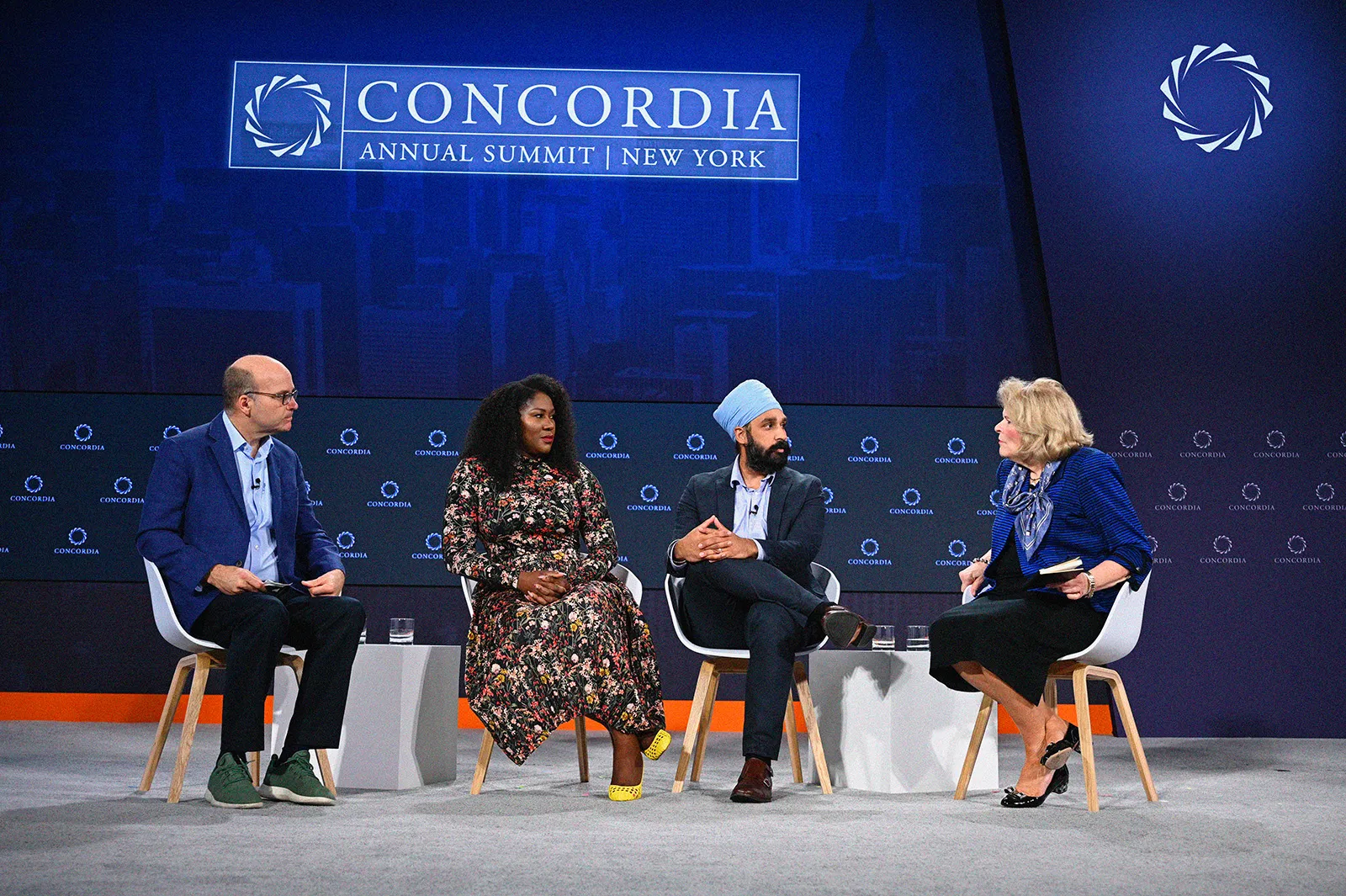
“Faith Fluency – a great term that speaks to understanding, speaking the language, being able to cover it.”
Keep the conversation going
Download the complete report, including social media assets.
 Visibility mattersDownload PNG
  The impact of coverageDownload PNG
  Representation mattersDownload PNG
  A call for equal attentionDownload PNG
  Faith in everyday lifeDownload PNG
  The audience opportunityDownload PNG
  Demand for qualityDownload PNG
  Room for nuanceDownload PNG
  Voices that informDownload PNG
  An engaged audienceDownload PNG
 In partnership with HarrisX. Original study
Back to top ↑