Positive Experience Index
Enjoyment, laughter, respect, learning and rest.
- Religious
- 69.0
- Not religious
- 65.0
Index score · Better outcomes

The worldwide connection between spirituality & wellbeing.
What helps us live well? Explore the role of meaning, belonging and connection in wellbeing around the world.
Introduction & methodology
At a time of widespread mental health and wellbeing challenges, this study explores how spirituality can support a more fulfilling life.
The report brings together a review of academic research, analysis of Gallup global data, and in-depth interviews. It considers physical, mental and emotional wellbeing, along with the experiences and practices that shape them.
“Religion” describes studies that asked specifically about religion or religious practice. “Spirituality” also includes individual practices such as prayer or meditation that connect a person with a higher being.
The findings describe statistical relationships, which vary by measure and social context. They do not establish that spirituality alone causes better health.
The main religious/non-religious comparisons use Gallup World Poll data from 2012–2022. In these analyses, religiosity reflects whether religion is important in daily life. Trend data cover 2008–2022; country models use 2008–2021 data and demographic and GDP controls. A separate question about spiritual connection was introduced in 2021.
The academic studies and interviews have their own methods and populations. Dates and units are identified beside each finding; percentage measures should not be confused with index scores or relative differences.
Read the report appendix and methodologyFaith & Wellness · Gallup · 2023
The state of spirituality & wellbeing
+4.0
index points in positive experiences among religious respondents: 69.0 compared with 65.0.
Gallup World Poll, 2012–2022. Other wellbeing measures show mixed results.
Compare all nine measuresSpiritual connection: Gallup World Poll, 2021 · Positive Experience Index: 2012–2022 · Report published 2023
01 · A nuanced picture
Gallup groups the nine outcomes by their relationship to religiosity. Explore the positive, similar and negative findings together.
Enjoyment, laughter, respect, learning and rest.
Index score · Better outcomes
Opportunities to meet people and friends or family to turn to.
Index score · Better outcomes
Expectations for future life, standard of living and the local economy.
Index score · Better outcomes
Everyday community conditions: environment, housing and infrastructure.
Index score · Better outcomes
Current life rated 7–10 and future life 8–10 on a 0–10 scale.
% of adults · No meaningful difference
Current and future life both rated 0–4. Lower is better.
% of adults · No meaningful difference
Current local economic conditions and whether the economy is improving.
Index score · No meaningful difference
Worry, sadness, anger, stress and physical pain. Higher is worse.
Index score · Worse outcomes
Health limitations, rest and freedom from pain and negative emotions.
Index score · Worse outcomes
| Measure | Religious | Not religious | Unit | Relationship |
|---|---|---|---|---|
| Positive Experience Index | 69.0 | 65.0 | Index score | Better |
| Social Life Index | 77.6 | 73.7 | Index score | Better |
| Optimism Index | 49.4 | 48.4 | Index score | Better |
| Community Basics Index | 59.7 | 55.6 | Index score | Better |
| Life evaluation: Thriving | 26.6 | 27.6 | % of adults | No meaningful difference |
| Life evaluation: Suffering | 13.3 | 13.6 | % of adults | No meaningful difference |
| Local Economic Confidence Index | 5.6 | 5.0 | Index score | No meaningful difference |
| Negative Experience Index | 31.4 | 29.9 | Index score | Worse |
| Personal Health Index | 66.9 | 68.6 | Index score | Worse |
Groups follow the published report. Higher Negative Experience scores mean more negative experiences. Thriving and suffering are percentages of adults; the other values are index scores.
Gallup World Poll, 2012–2022. Values are reproduced as published.
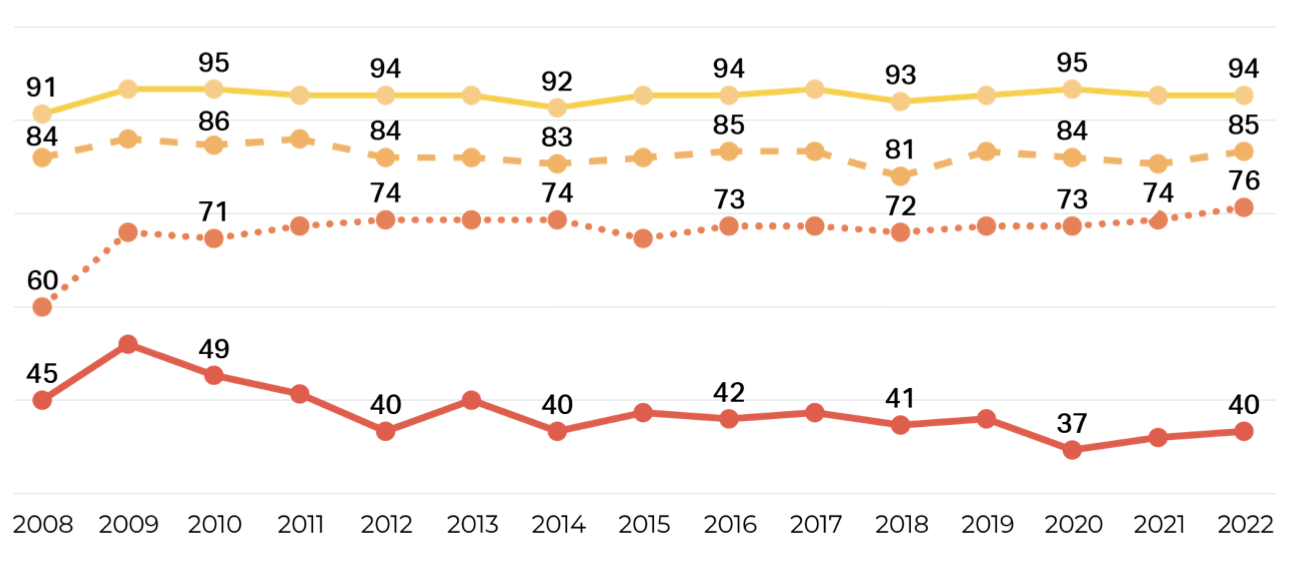
02 · Patterns over time
Religiosity declined in high-income countries over the period studied, while remaining comparatively stable in lower-income countries.
Share of adults (%) · Selected labelled years from the source chart, 2008–2022; connecting lines link observations. Income groups follow World Bank 2023 categories.
| Income group | 2008 | 2010 | 2012 | 2014 | 2016 | 2018 | 2020 | 2022 |
|---|---|---|---|---|---|---|---|---|
| Low-income | 91% | 95% | 94% | 92% | 94% | 93% | 95% | 94% |
| Lower-middle-income | 84% | 86% | 84% | 83% | 85% | 81% | 84% | 85% |
| Upper-middle-income | 60% | 71% | 74% | 74% | 73% | 72% | 73% | 76% |
| High-income | 45% | 49% | 40% | 40% | 42% | 41% | 37% | 40% |
In the U.S., the report describes declines in religious identity, importance, attendance and membership. At the individual level, it also reviews associations between religiosity and higher wellbeing, healthier behaviors and a lower likelihood of a lifetime depression diagnosis, even after accounting for demographic differences.
Faith & Wellness · Gallup · 2023

Beyond religious affiliation
The 2021 World Poll asked how often people felt connected to a religion or form of spirituality. Just over half answered “always” or “often.”
After controlling for other predictors such as age and income, spiritual connection had a positive, meaningful relationship with wellbeing globally. Regional results varied, and were not statistically meaningful in Europe and Latin America.
Faith & Wellness · Gallup · 2023
A new framework
The report identifies five aspects of spirituality that can support mental health and wellbeing. Explore the evidence and the conditions that matter.
The five dimensions
A sense of meaning can help people navigate difficult experiences.
Spiritual practice can offer a worldview for understanding suffering and a source of purpose, peace and forgiveness. The report reviews research connecting religious or spiritual involvement with optimism, hope, self-esteem and coping with adversity, alongside lower rates of depression, substance abuse and suicidal behavior in many studies.
A Harvard study cited in the report found frequent prayer or meditation was associated with a 47% greater likelihood of having a sense of mission and purpose. This is a relative comparison between groups, not the percentage of all people who have purpose.
The relationship is not uniformly positive. Studies of prayer and anxiety have mixed findings. Feeling abandoned or punished by a higher power is associated with poorer outcomes; retaining personal agency while viewing a higher power as a partner is associated with better outcomes.
Faith & Wellness · Gallup · 2023
The five dimensions
Belonging creates a network to turn to.
Religious respondents reported greater satisfaction with opportunities to meet people and make friends, and greater access to friends or relatives they could count on in times of trouble.
The report translates these differences into population-scale estimates: approximately 200 million additional people satisfied with opportunities to meet others and 100 million with someone to turn to. These are modeled equivalents of the observed gaps, not a count of people shown to benefit from an intervention.
The relationship between religious importance and positive experiences varies by place. It is often stronger in lower-income African and Asian countries, and weaker or slightly negative in many European countries.
The source map shows larger positive associations in many African and Asian countries, with weaker or negative associations in parts of Europe. Grey indicates no statistically significant effect; unshaded countries were not included. Colors represent model t-statistics, not percentages.
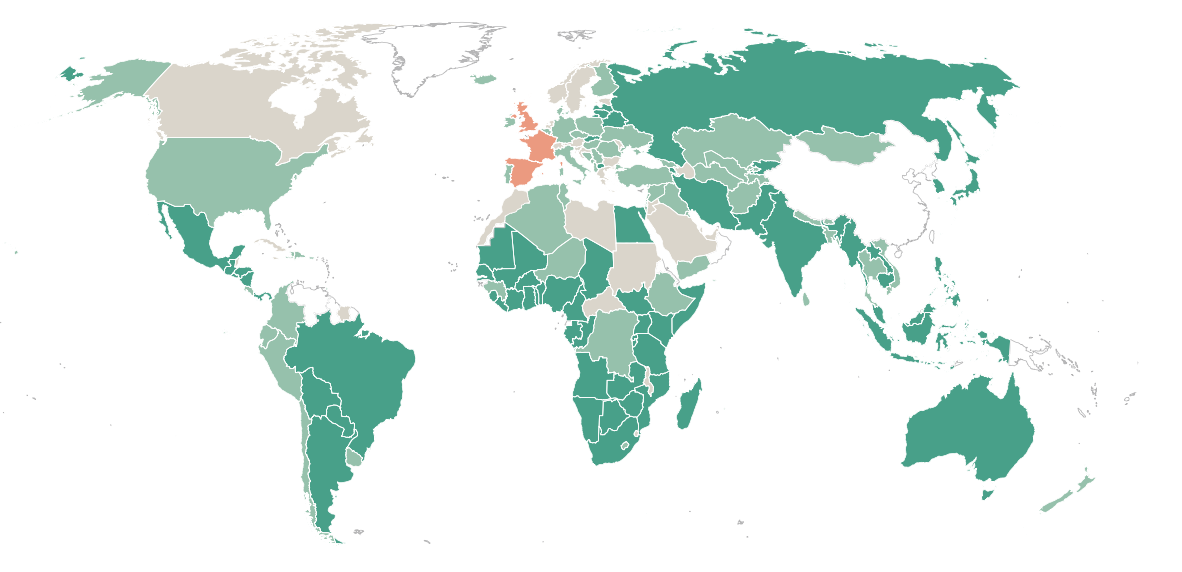 View original figure at full size
 Faith & Wellness · Gallup · 2023
Faith & Wellness · Gallup · 2023
The five dimensions
Connection can become action for others.
Many faith traditions encourage service, volunteering and a sense of responsibility to neighbors. These practices can strengthen belonging while supporting the wider community.
Respondents who say religion is important score higher on Gallup’s Civic Engagement Index across all eight global and regional comparisons shown below. The largest regional gap is in Northern America: 10.3 index points.
Index scores on a shared 0–100 scale. The gap is shown in index points.
| Region | Religious | Not religious | Difference (points) |
|---|---|---|---|
| Global | 35.8 | 31.0 | 4.8 |
| Northern America | 58.8 | 48.5 | 10.3 |
| East Asia & Pacific | 42.8 | 35.2 | 7.6 |
| Latin America & Caribbean | 36.3 | 30.9 | 5.4 |
| South Asia | 34.6 | 29.7 | 4.9 |
| Europe & Central Asia | 35.6 | 30.9 | 4.7 |
| Sub-Saharan Africa | 33.3 | 28.8 | 4.5 |
| Middle East & North Africa | 33.1 | 31.4 | 1.7 |
The source chart compares modeled effects of spiritual connection on wellbeing. Australia and New Zealand show the largest positive bar; the European Union is negative. The report says regional effects were statistically meaningful except in Europe and Latin America. The original figure provides no numerical axis, so bar heights should not be read as percentages.
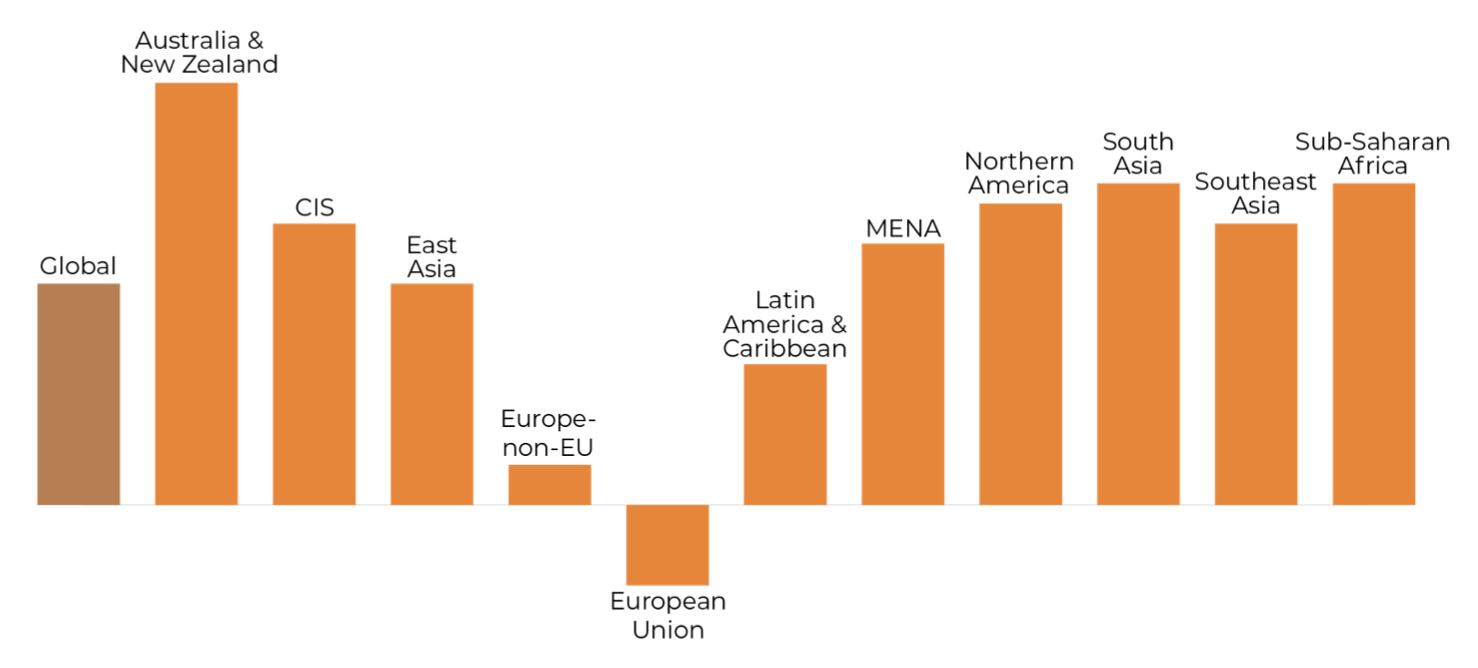 View original figure at full size
 Faith & Wellness · Gallup · 2023
Faith & Wellness · Gallup · 2023
The five dimensions
Shared beliefs and social bonds can provide a steady point of reference.
Religious communities can offer structure, common rituals and support in challenging circumstances. A systematic review cited in the report found that 13 of 21 studies connected religiosity or spirituality with a stronger sense of control.
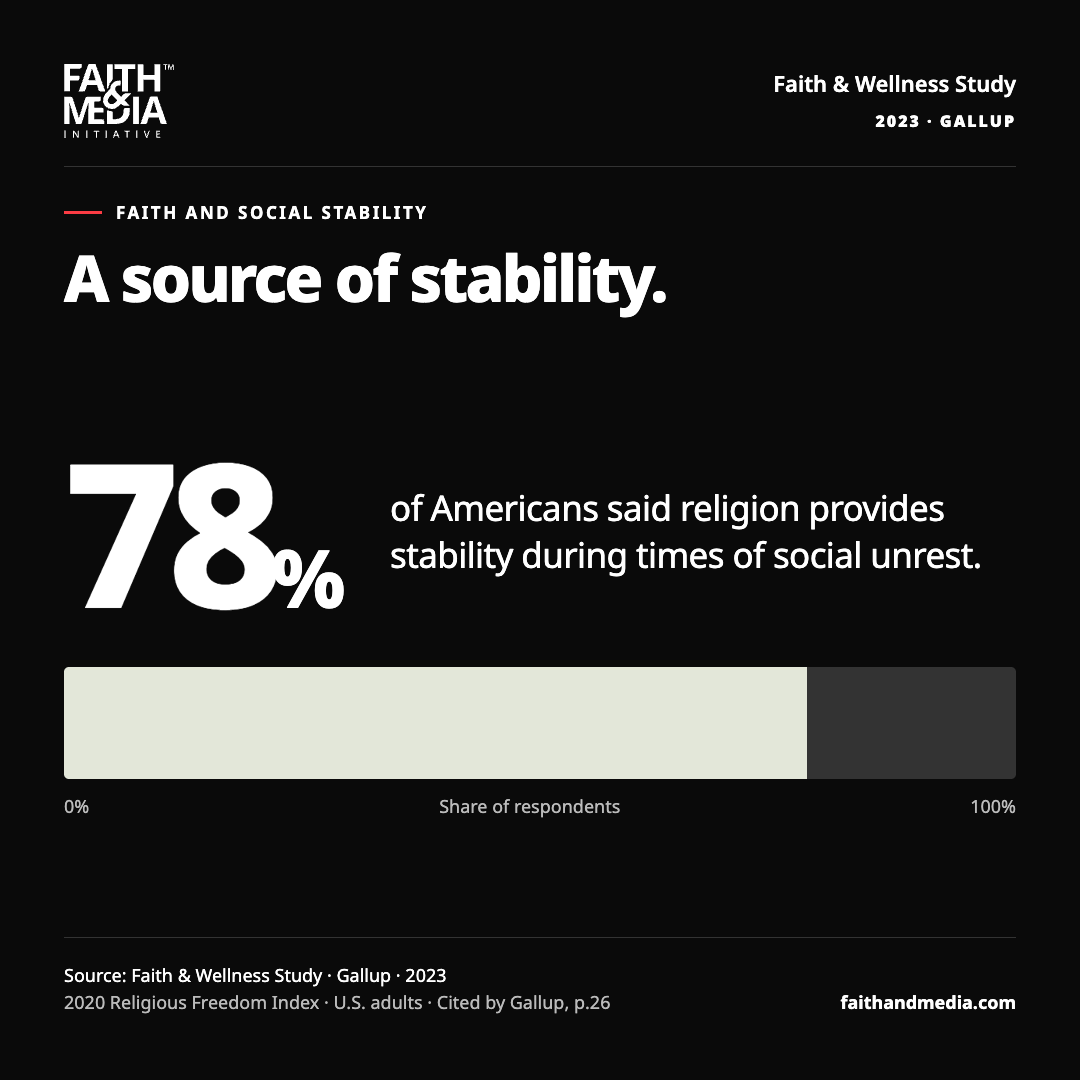
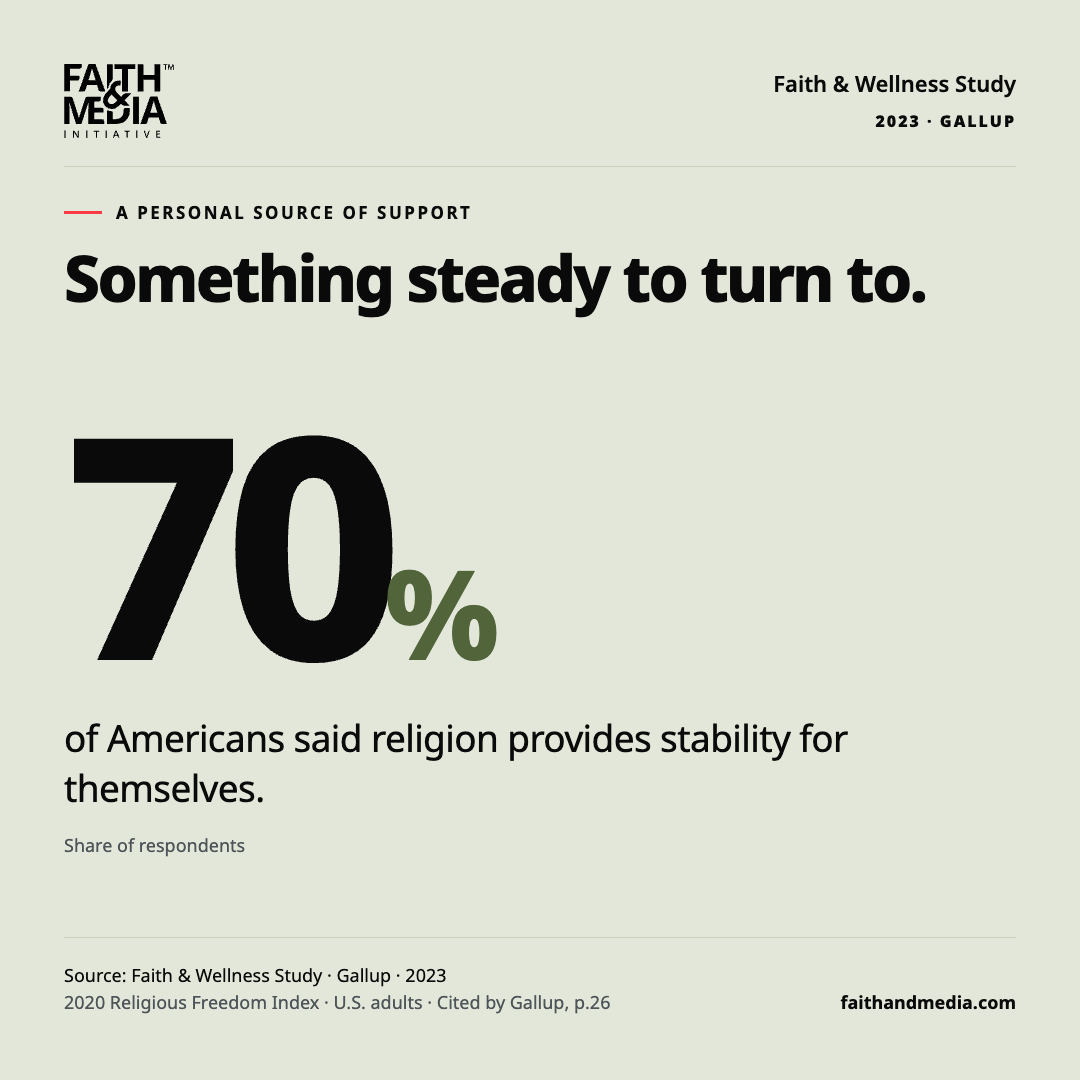
The 2020 Religious Freedom Index Report, conducted during the pandemic and a period of widespread protests, explored religion’s perceived contribution to stability. The findings below describe Americans surveyed in that study.
78%
said religion provides stability during social unrest.
70%
said religion provides stability for themselves.
Americans surveyed · 2020 Religious Freedom Index Report, cited by Gallup (2023).
Faith & Wellness · Gallup · 2023
The five dimensions
People need room to bring their whole selves to work.
Spirituality can help employees cope with stressful situations, but its relationship to wellbeing at work depends on psychological safety. Support for expressing beliefs can help; conflict between religious and work identities can harm wellbeing.
Voluntary faith and interfaith employee resource groups offer one approach. The report emphasizes respect across traditions and worldviews, including people who are not religious. Employees can feel that their views are honored without being asked to adopt someone else’s.
David W. Miller of Princeton’s Faith & Work Initiative describes four common responses: avoiding faith, tolerating it without formal support, privileging a single tradition, or welcoming all faiths and worldviews equally.
The 2023 report cites these estimates from different sources and populations. They describe distinct costs and should not be added together.
Faith & Wellness · Gallup · 2023
Examining a paradox
Despite potential benefits, religion and spirituality are declining in the U.S. and many other places. The report explores five possible reasons.
Faith & Wellness · Gallup · 2023
Evidence about spirituality and wellbeing is not always widely understood. Researchers, educators, faith communities and news media can help communicate the findings accurately, including their limits.
Exclusion and hostility toward people outside a group can undermine belonging and wellbeing. Welcoming communities and respect across differences matter.
Faith can be perceived as a source of conflict when it becomes entangled with political or cultural divisions. The social context changes how people experience religion.
Younger generations are often less affiliated and may view religious institutions differently. Open conversations about meaning and purpose can create space for connection.
Belief, behavior and belonging change over time. Some people seek meaning outside formal institutions; shared community and purpose can take multiple forms.
Conclusion & considerations for leaders
Workplaces, schools, hospitals, governments and community organizations can use these findings to broaden how they think about wellbeing.
Communicate the evidence accurately. Recognize both the potential benefits and the ways exclusion, negative coping or social conflict can undermine wellbeing.
Support voluntary opportunities for connection and service. Respect religious and nonreligious worldviews, and make psychological safety part of the experience.
Consider faith and community partnerships alongside broader wellbeing services. Learn from initiatives across cultures, and share what works.
The report describes substantial personal and organizational costs of poor mental health, including more unplanned absences and lost productivity. Its call to leaders is to consider spirituality within a broader set of supports for human wellbeing, while recognizing that context and individual experience matter.
Faith & Wellness · Gallup · 2023
Keep exploring
Read the full 72-page report, including methodology, interviews, references and appendices.
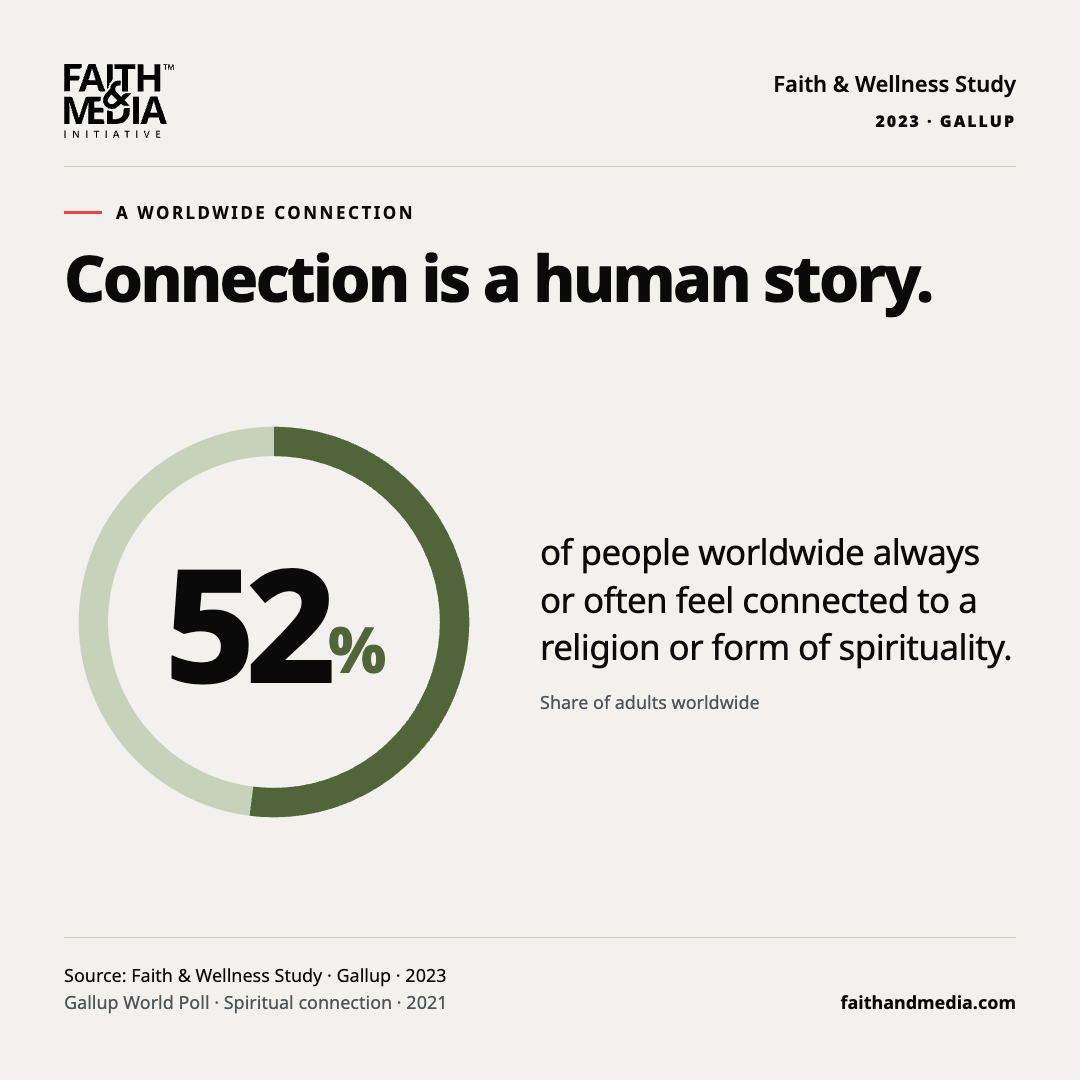 A worldwide connectionDownload PNG
  Faith and social stabilityDownload PNG
  A personal source of supportDownload PNG
 Faith & Wellness · In partnership with Gallup · Published 2023. Report copyright © 2023 Gallup, Inc. Original study and report highlights
Explore all research